Vital Statistics
Robert Pinsent: 1562 – 1626: GRO1758 (Woodhouse Down and Huxbeare Barton)
Dorothy Carpenter: 1565 – 1643
Married: 1586: Hennock
Children by Dorothy Carpenter:
Simon Pinsent: 1587 – xxxx (Married Elizabeth Stevens of London)
Robert Pinsent: 1589 – 1650 (Married Agnes Stevens of Ipplepen, 1655)
Dorothy Pinsent: xxxx – 1590
William Pinsent: 1591 – 1591
Helen Pinsent: 1592 – xxxx
Thomas Pinsent: 1597 – 1649 (Married Julian Stidstone, 1617; took over Huxbeare Barton in 1626)
George Pinsent: 1599 – xxxx
John Pinsent: xxxx – 1600
Family Branch: Devonport
PinsentID: GRO1758
Click here to view close family members.
Robert Pinsent was, most likely, an early son of William Pinsent of “Huxbeare Barton,” a significant farm on the west side of the River Teign, in Hennock. However, the clerk who recorded his baptism failed to mention his parents’ names or his place of birth for that matter, so there is still an element of doubt. He would have been the son of William’s first wife, Joan, who died in 1590.
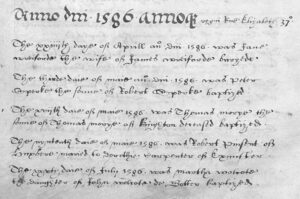
Robert Pinsent was definitely “of Huxbeare” when he married Dorothy Carpenter, of Exminster, in 1586 and the parish “Churchwardens’ Accounts” tell us that William and his son Robert paid the rates for “Huxbeare” in 1598. They also tell us that Robert and his (presumed) stepmother (another Joan: née Lambshead) shared the responsibility in 1603. William had, presumably, died in the interim. His widow would have been entitled to a life-interest in one third of his property – so she likely paid for one “moiety” (share) and Robert paid for the other two. Robert and and his own wife Dorothy were living at another family farm, “Woodhouse Down,” when his father died. This passed out of the family in the 1700s but it was still in existence when the Parish Tithes were commuted in the 1840s. “Woodhouse” is on the west bank of the Teign River a few miles south of “Huxbeare.” It is close to the main Chudleigh road bridge. The Accounts show Robert was paying the parishes rates for both farms by 1605. His step-mother must have either died or remarried.
By 1616, Robert was also paying the parish rate for “Creda (Cressida) Downs”. I am not sure where they are. There had been Pinsents living in Hennock for a long time and some of the land may have been in the family for generations. Some may have been “copyhold” land – land that was technically “owned” by the feudal Lord of the Manor but allocated to a named family (essentially) in perpetuity – subject, of course, to rent and other feudal obligations that were written or “copied” into the Manor Roll. If the copy-holder bought-out his rent and other obligations it became “freehold” and thus, importantly, available for transfer and sale. I do not know how much of Robert’s holdings were, by then, “freehold” and how much “copyhold.” However, I do know that Robert also controlled some “leasehold” land.
Mr. William Honeywell, a local gentleman, kept a diary in which he listed the property he rented out in February 1604/5. He leased “To Robert Pynsentt, the Mill Marsh and Meadow below, for £3 6s 8d”. The following December Mr. Honeywell made a note of the fact that he “went to Woodhouse and there sold to Robert Pynsent and his wife 36 pounds of pewter dishes at 7d per pound, which came to 21/-.” Robert and Dorothy were moving up from wooden bowls and platters! Their finances must have improved after they moved to “Huxbeare” as they could then afford servants. The parish register refers to the death of Zachary Brooking “servant to Robert Pinsent.” He was buried on 2nd September 1612. It also tells us that Dorothy Carpenter “servant of Robert Pinsent of Huxbeare” was buried on 26th October 1618. Presumably she was probably one of his wife’s relations.
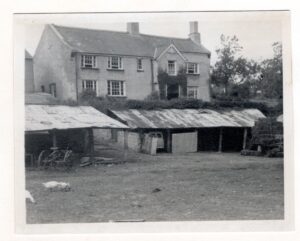
Whether they realized it or not, Robert and Dorothy lived in interesting times. Elizabeth I had come to the throne shortly before they were born and the country was still reeling from the changes her father (Henry VIII) and her elder sister (Mary) had made to the State religion. When she came to the throne she, sensibly, instituted a compromise form of Protestantism that provided stability in the country at a time when much of Europe was still in a state of political and religious upheaval.
Robert married Dorothy two years before the Spanish Armada arrived off the Devonshire coast and Sir Francis Drake played his famous game of bowls on the Hoe at Plymouth (presumably waiting for the tide to turn before setting out to sea). Elizabeth I died in 1603 and Robert and Dorothy also lived through the turbulent reign of James I. One of their sons (Simon Pinsent) was in London a couple of years after Guy Fawkes was caught trying to blow up the Houses of Parliament: (“gun-powder treason and plot”).
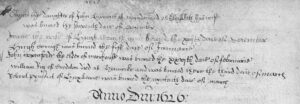
Robert died in 1626 and my great grandfather – Sir Robert John Pinsent – said he found a memorial to him “just inside the chancel” when he visited Hennock in 1860. I could not find it when I went looking in the 1960s.
Robert’s wife, Dorothy (née Carpenter) died in 1643, so she also lived to see King Charles I break with Parliament and raise his standard at Nottingham at the start the English Civil War in 1642. What she made of it all, I have no idea!
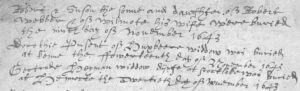
Robert and Dorothy had six sons (Simon Pinsent, Robert Pinsent, William Pinsent, Thomas Pinsent, George Pinsent and John Pinsent) and two daughters, (Dorothy Pinsent and Helen Pinsent) between 1587 and 1600. Life expectancy was; however, low and only two of their sons seem to have grown up and had families of their own.
Their eldest son, Simon, survived childhood and, in an entry in his diary dated 25th April 1607, Mr. Honeywell writes: “I went to Chudleigh Market and there delivered unto Jervis, Mr. Eastchurch’s man, my letter unto Simon Pynsent, in London, for to receive the £8 5s that I had charged his master with in my yellow paper book. There I received his master’s note of debt to the same effect.” Simon would have been 20 years old at the time. He must have been working in London and a useful point of contact. Simon probably married Elizabeth Stevens in St. Gregory by St. Paul’s Parish in London in November 1609. Whether she was a Devonian, and related to the Agnes Stevens we shall meet below, I do not know. I can find no evidence of them having had children. London was not a particularly healthy place and Simon may well have died while there. He seems to have predeceased his father – who died in 1626. Had he not, he would have been first in line to inherit the family farm at “Huxbeare”.
Robert and Dorothy Pinsent’s eldest surviving son, Robert Pinsent married a girl called Agnes Stevens from Ipplepen and moved to Bovey Tracey. What he did there I do not know. Agnes’s family had connections in London and it is tempting to suggest that she was Elizabeth Steven’s sister; however, I cannot say for sure. I am not aware that either family owned land in Bovey Tracey. It looks as if Robert’s younger brother, Thomas Pinsent stayed on in Hennock and helped his father run the family estate.
Thomas married Julian Stidstone, a widow, from Dartington, in 1617 and inherited most of the family holdings (including “Huxbeare”) when his father died.
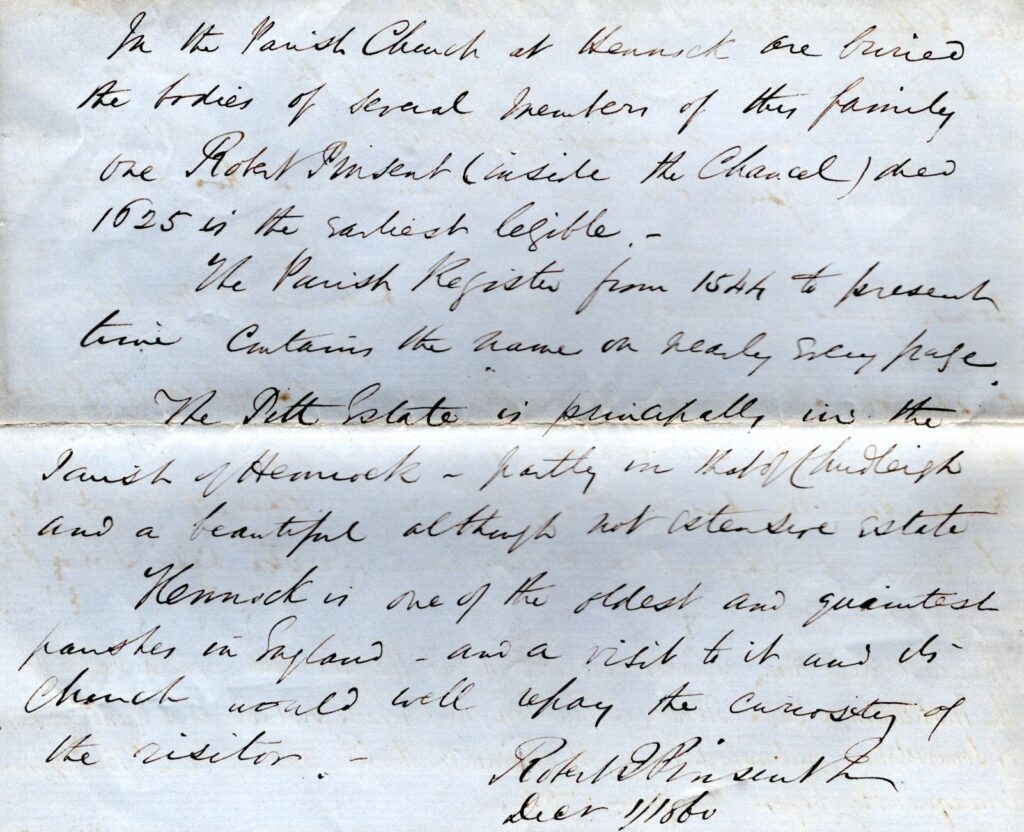
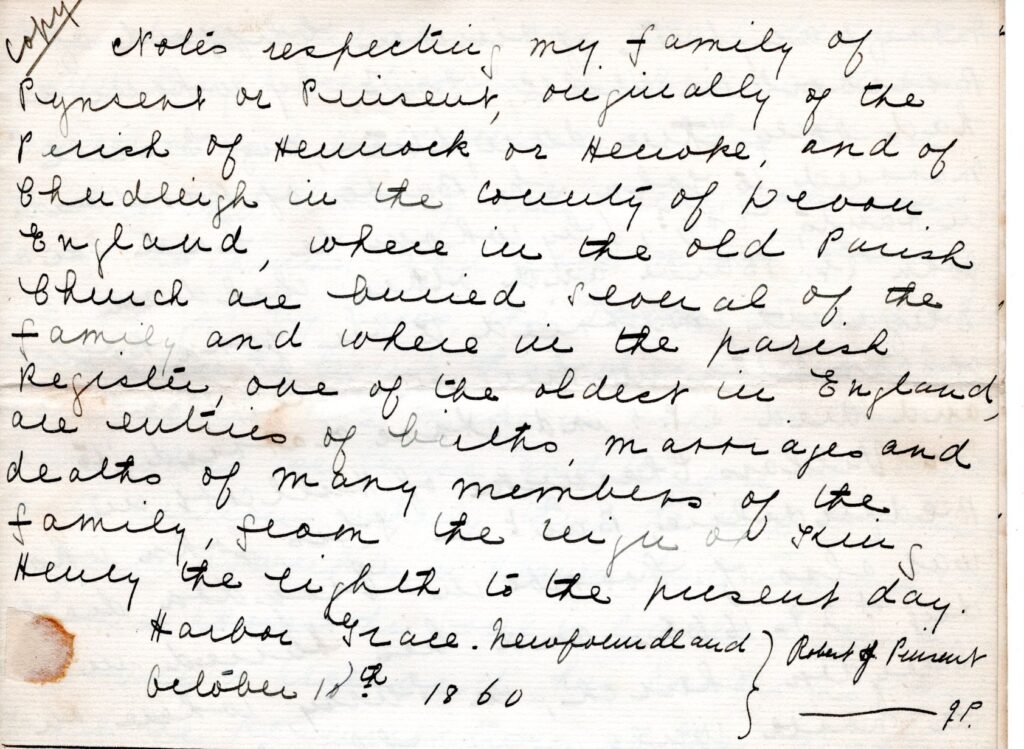
Robert seems to have been buried in the chancel of Hennock Church. It is no-longer visible but I have seen references to it. Whether my great-grandfather, Robert John Pinsent (later Sir Robert J. Pinsent) saw it I am not sure. In a note while in Devon on a visit in 1860 he states that: “In the Parish Church at Hennock are buried the bodies of several members of the family. One Robert Pinsent (inside the Chancel) died in 1625 is the earliest legible.” Robert’s widow, Dorothy Pinsent of “Huxbeare” lived on. She did not die until 1643, early in the Civil War.
Robert “junior’s” brother George was baptized in Exminster in 1598/9. He may have married Elizabeth Soper and he may have also moved to Bovey Tracey. If so, he may be the George Pinsent “Butcher of Bovey Tracey” who was charged in the “Court of King’s Bench” in 1642 over a matter of a debt that he owed to Anthony Gribble (KB27/1676 m178d).
It is not clear what happened to Robert and Dorothy’s younger daughter, Helen. However, it seems clear that her elder sister, Dorothy, was buried in Exminster in 1590. This shows a residual attachment to Robert’s wife’s parish of birth. Their sons William and John both died young.
Family Tree
Parents
Father: William Pinsent: 1527 – 1601
Mother: Joan Unknown: 1535 – 1590
Please use the above links to explore this branch of the family tree. The default “Next” and “Previous” links below may lead to other unrelated branches.