Vital Statistics
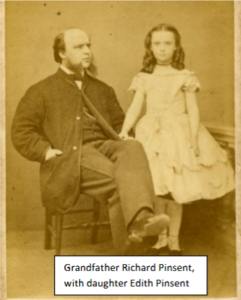
Richard Steele Pinsent: 1820 – 1864 GRO0741 (Draper, Devonport, Devon)
Catherine Agnes Ross: 1830 – 1906
Married: 1850: Stoke Damerel, Devon
Children by Catherine Agnes Ross:
Adolphus Ross Pinsent: 1851 – 1929 (Company Director, Married, 1877, Alice Mary Nuttall, 1902, Ethel Mary Philomena Whitelaw and had children).
Richard Alfred Pinsent: 1852 – 1948 (Solicitor, Knight, Married 1878, Laura Proctor Ryland and had children).
Edith Mary Pinsent: 1853 – xxxx (Married, 1880, John Haynes Radford, a draper from Compton Gifford, Devon)
Hume Chancellor Pinsent: 1857 – 1920 (Solicitor, Married, 1888, Ellen Frances Parker, Dame, and had children)
Family Branch: Devonport
PinsentID: GRO0741
Click here to view close family members.
Richard Steele (1821-1864) was the fourth and youngest of the three surviving sons of Thomas Pinsent, a draper in Devonport, by his wife Mary (née Savery). He was born at #4 Stoke Terrace, Stoke Damerel (Plymouth) on 19th December 1820 and grew up in Devonport. He did well at school and both won prizes and received certificates for French, German, Philosophy in July 1837 (Patriot: 6th July 1837). His father owned a farm called “Greenhills” in Kingsteignton and Richard and his brothers (Savery, John Ball and Thomas) also grew up there. Sadly, Thomas junior died young. Nevertheless, the others reached maturity and Thomas senior bought into a brewery in Highweek (Newton Abbot) for his son John Ball Pinsent to run, and he arranged for Savery Pinsent to article with a local lawyer. Having done his duty by his two older sons, Thomas “retired” to his farm in Kingsteignton in the 1840s, leaving Richard Steele to manage the Devonport drapery.
Thomas was a “dissenter” and it is not surprising that his son Richard signed on to a letter of appeal to the “Nonconformist Electors of Great Britain” urging them to take a stand against politicians who, they thought, had questionable motives when it came to the “true religion” (Norfolk News: Saturday 26th June 1847). Richard was a relatively wealthy member of the “Hope Chapel” in Devonport, so when the Rev. Mr. Spurgeon (a popular preacher) visited Plymouth in 1857 and appealed for money to reduce the Chapel’s debts (which then amounted to £1,743), Mr. Pinsent (Richard Steele) said that he and his father would give £100. The Rev. T. Horton (Richard’s brother-in-law), who was the pastor of the chapel, also agreed to chip in another £100.
In 1859, Thomas Pinsent and one of his sons (probably Richard Steele as Savery was in Natal and John Ball had little time for religion) went to Birmingham to attend the funeral of a noted Midland “dissenter” – the late Rev. John Angell James. He was Thomas’s deceased daughter Sarah’s, father-in-law (Birmingham Gazette: Monday 10th March 1859), which explains the connection.
Richard was actively involved in the management of the “Hope Chapel” and he must have been pleased to inform the congregation in 1860 that the Chapel’s finances were now in good shape (Liverpool Daily Post: Monday 19th March 1860). Presumably the Rev. Spurgeon’s appeal had worked, and the chapel had managed to retire its debt. It was a charitable age, and Richard S. Pinsent was one of many donors (£50) to the “Devonport, Stonehouse and Cornwall Hospital” which was planned to be built on a site adjacent to the “Devonport Dispensary” (Royal Cornwall Gazette: Friday 22nd March 1861)
Richard Steele Pinsent was living at #40 St. Aubyn Street, Stoke Damerel, in 1850, when he married Catherine Agnes Ross. She was the third daughter of a Scottish “medical practitioner,” Adolphus McDougall Ross, Esquire, and the granddaughter of David Hume Esquire – “Baron Hume of Ninewells”, one of the Barons of the Court of Exchequer in Scotland (Caledonian Mercury: Monday March 4th 1850). Catherine had been born in Edinburgh in around 1830. She was a direct descendant of John Hume, a brother of the Scottish Philosopher, David Hume (1711 – 1766).
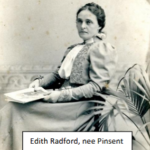
The couple had three sons (Adolphus Ross Pinsent, Richard Alfred Pinsent and Hume Chancellor Pinsent) and a daughter (Edith Mary Pinsent) – all of whom appear to have channeled their Scottish ancestor’s intelligence and ability. Adolphus Ross, the eldest son, went into business in South America and his descendants can still be found there. Richard Alfred (later Sir Richard Alfred), the middle son, founded “Pinsent and Co.”, the Birmingham law firm and Hume Chancellor, the youngest, was called to the bar at the “Middle Temple” in November 1882 and became a partner in the law firm. Hume Chancellor married Ellen Frances Parker (later Dame Ellen Frafnces Pinsent). She was a well-respected novelist and mental health activist. The lives and descent of each of them are described elsewhere. Richard’s daughter, Edith Mary, married a draper. Sadly, Richard and Catherine also had two stillborn daughters – in January in 1862 (Western Times: Saturday 11th January 1862) and September 1864 (Glasgow Courier: Thursday 15th September 1864). The latter arrived after Richard’s death.
However, those days were yet to come. At the time of the 1841 census, Richard Steele was an still an unmarried draper lodging with other Baptists in St. Martin, Vintry, in the City of London. He may have been there on a shopping expedition for his father. However, when the next census (1851) was taken, he was married and was living with his wife Catherine and their two-month old baby, Adolphus, at #40 St. Aubyn Street. They probably moved shortly thereafter, as the property “No. 49, in St. Aubyn Street, Devonport (in the possession of Messrs. Pinsent) together with the Stable and Dwelling House in Barrack Street, (in the possession of Mr. Dunn) at the rear thereof” which had a rental value of £55 per annum in aggregate, was sold out from underneath them at auction on February 5th 1852 (Exeter Flying Post: Thursday 22nd January 1852). The family moved to #34 Ker Street, which is where they were to be found on 8th April 1861 – the next census. Richard and Catherine were living there with their daughter Edith M., their son Hume C. and three servants. The elder children, Adolphus Ross Pinsent and Richard Alfred Pinsent (see below) may have been away at school.
Richard Steele ran the firm of “Pinsent & Co.”, a “Linen and Woolen Drapery, Shawl, Mantle and Millinery establishment; carpet, Damask and General Furnishings, Woolen Cloth and Wholesale Scotch and Manchester Warehouse” business from around 1843 until his death, aged 43, in 1864. The firm was located at #31, #32 & #33 Market Street in Devonport (White’s Directory; 1850). Another source describes it as a “Wholesale and retain linen and woollen drapers and silk mercers, hosiers and haberdashers at 33 Market Street, Devonport” (Western Courier, West of England Conservative, Plymouth and Devonport Advertiser: Wednesday 16th September 1846). Richard was determined to cover all the bases!
Richard Steele’s father, Thomas Pinsent, had founded “Pinsent & Co.” shortly after his marriage to Mary Savery, in 1805, and had built it into a flourishing enterprise. He did this partly by acquiring cheap merchandise from the trustees of less-fortunate, bankrupt, drapers, and partly through the variety of the merchandise it sold. The firm also harnessed the power of advertising. For instance, Thomas bought £16,000 worth of stock from the assignees of Edward Blake of 34 Catherine Street in Plymouth and advertised it for sale “at a great reduction for ready money” in November, 1840 (Western Courier, West of England Conservative, Plymouth and Devonport Advertiser: Wednesday 11th November 1840).
Thomas was quick to realize the excitement that could be engendered by bringing in new fabrics from Lancashire and the North, and by selling the latest fashions from London. “Pinsent & Co.” seem to have owed much of its success to finding and selling good quality manufactured goods from London, Scotland, Lancashire, Yorkshire and elsewhere (Western Courier, West of England Conservative, Plymouth and Devonport Advertiser: Wednesday 16th September 1846). The firm was not shy about advertising its products, and the local newspapers were full of advertisements extolling its Printed Muslins, Robes, Cambrics, Shawls, Ribbons, Gloves, “Silks for Young Ladies’ Dresses” etc. (Western Courier, West of England Conservative, Plymouth and Devonport Advertiser: Wednesday 24th August 1853).
Working conditions for the staff at “Pinsent and Co.” improved in 1847 when the company (in line with other businesses) reduced its working hours. The closure time was set at 7 p.m. in the winter months, 8 p.m. in April, May, August and September, and 9 p.m. in June and July (Western Courier and West of England Conservative, Plymouth and Devonport Advertiser: Wednesday 10th November 1847). The company was constantly on the lookout for good employees; such as the “energetic young man” required for the “Print and Calico Department” and the various apprentices that it sought to learn the “general business” (Western Times: Saturday 20th February 1858)
When Mr. Thomas Dingle died in 1840, he left “Richard Steele Pinsent, son of Thomas Pinsent, Draper of Devonport, “ as one of his three trustees (Inland Revenue: Stamp Office Wills: 1840). The first mention I have found of Richard Steele (actually Mr. Pinsent, junr.) acting alone with respect to the business comes shortly after Thomas dissolved a partnership he had with Joseph Nicholson and William Martin, in March 1843. After announcing yet another major reduction in stock brought about by the dissolution of the partnership (involving “A GREAT SACRIFICE!!!” on the company’s behalf) the public were informed that Mr. Pinsent Jnr. was in London on a shopping expedition (Western Courier, West of England Conservative, Plymouth and Devonport Advertiser: Wednesday 19th April 1843).
Richard Steele seems to have taken over the day to day running of the business in the mid 1840s when his father moved back to Kingsteignton; however, Thomas remained the senior partner in the enterprise until 31st December 1859 (Perry’s Bankrupt Gazette: Saturday 25th May 1861). Richard Steele must have earned a reputation for honesty as, in 1852, the trustees of Joseph Hoyten, a Cornish draper, assigned his personal estate to Peter Adams and Richard Steele Pinsent to distribute to the benefit of his creditors (London Gazette: 26th October 1852). Similarly, a few years later, Edwin Barrett Corse, a bankrupt Plymouth draper, had his estate assigned to William Brock and Richard Steele Pinsent, who were, again, to act as trustees for his creditors (Daily News: Tuesday 15th December 1857). There were other examples.
The firm’s business model worked well for the most part; however, it could be undone by poor bookkeeping! “Pinsent and Co.” bought up the remaining stock of a draper called John Brook and they later tangled over the price he should be paid. The case was heard in “East Stonehouse County Court”. Richard Steele claimed that when he took possession of Mr. Brook’s stock and prepared it for sale he found discrepancies between the prices expected and what was actually marked on some of the items, and he responded accordingly – presumably trying to reduce the overall purchase prize. Mr. Brook, meanwhile, felt he should receive what he had been promised.
Unfortunately for Richard, as Mr. Horton (presumably his nephew, Thomas Pinsent Horton) admitted in Court, the firm had been so busy preparing the product for sale that they had not bothered to compile a detailed list of the discrepancies; however, he was able to quote some examples … The episode did not reflect well on either company’s book keeping! His Honour, Mr. Justice Fortescue gave a judgement for £14 2s 6d in favour of Mr. Brook (Western Daily Mercury: Wednesday 23rd April 1862). “Pinsent and Co.,” meanwhile, grew on the back of its advertising and it became the Devonport outlet and agent for other firms, including “Atkinson’s.” For several years, Richard sold their “cheap and durable steel collars” and “steel cuffs” (perfect comfort, whiteness and fit assured) (Western Daily Mercury: Monday 27th July, 1863).
Richard seems to have been good employer, by the standards of the day at any rate. When an irrate, but suitably anonymous, “draper’s assistant” wrote to the the editor of the Western Daily Mercury regarding the decision by several local employers to increase their employees’ hours of work over the winter months he specifically excluded “Messrs. Pinsent and Co.” from his tirade (Western Daily Mercury: Thursday 9th October 1862).
Whether or not “Pinsent and Co.” actually grew through contracts to supply the military (“Royal Navy” and “Royal Marines”) in Plymouth and Devonport as I have seen suggested is unclear; however Richard Steele was certainly a benefactor of the “Royal Naval and Military Free School” in Devonport. When he died, its trustees ruefully acknowledged that the annual subscriptions he gave to their cause would be sadly missed … (Western Daily Mercury: Wednesday 27th April 1864). He was “a liberal donor to the charities of the town” (Western Daily Mercury: Monday 15th February 1864). Like his father, Richard was politically liberal too (Western Daily Mercury: Saturday 14th February 1863).
Richard seems to have had regular contracts with the “Commissioners of the Workhouse in Devonport”. This can be seen from lists of their purchases published in the press, and also from a spat they had in 1851. Mr. Pinsent (presumably Richard Steele) had submitted a tender – part of which was for “ticklenburgh” (a coarse linen fabric made in Germany). The “Commissioners” accepted the bid but later objected to the quality of the fabric they received. They wanted restitution! However, this was complicated by the fact that the final contract had never been signed. It had lain on someone’s desk awaiting for Richard’s signature. Mr. Pinsent was thus morally bound to replace the cloth; however, he was not legally obliged to do so. In a panic, the “Commissioners” called him in and after much discussion he comparing his originally tender to the contract – and agreed to honour it – despite the fact that “ticklenburgh” had significantly increased in price. Richard Steele had supplied the “Workhouse” for several years and he would have been reluctant to offend the “Commissioners” (Western Courier, West of England Conservative, Plymouth and Devonport Advertiser: Wednesday 12th February 1851).
In 1855, William Lucas, an errand boy found a £40 bank post-bill (“cheque”) and tried to cash it at “Pinsent and Co.’s” Market Street store. When he first tried, he claimed it was for a local grocer. He was told to get the grocer (Mr. Elliott) to endorsed it and then come back. This was, of course, out of the question; so he forged Mr. Elliott’s name and returned to claim his prize. The note was sent to the “Devon and Cornwall Bank,” where a sharp-eyed member of staff examined the signature and raised the alarm. A few days later, two of “Pinsent and Co.’s” staff found the boy and brought him back to the store to be questioned and handed over to the police. Mr. Pinsent found that he still had £33 still in his possession. In Court, Henry White “an intelligent lad, between 12 and 13 years of age” described how Lucas had gone about forging the grocer’s name and perpetrating the scam. He also described how Lucas had bought a gun – for collection the next day, and how the two of them had taken an “omnibus” (bus) to “Plymouth Fair”. They thoroughly enjoyed themselves and, after eating “two four-penny plates of meat each” at Mrs. Windeatt’s eating-house, they went home. This riotous living came to an end when Lucas was caught practicing with the gun, shooting at a dead dog in a “shooting trench”. (London Daily Express: Wednesday 11th April 1855).
By drawing attention to themselves, “Pinsent and Co.”, inevitably made themselves a mark for thieves and con-men. In 1854, “Pinsent & Co.” specifically encouraged those “Ladies’ and Gentlemen, Strangers and Others Furnishing Houses in this neighbourhood” to “visit Pinsent & Co.’s Furnishing Drapery Warehouse, No. 32, Market Street, Devonport, Where is to be seen one of the largest stocks in the West of England of Tapestry, Brussels, Kidderminster and Dutch Carpeting, Silk and Worsted Damasks, Linen and Cotton Sheetings, Blankets, Counterpanes, Table Linen, Table Covers etc” (Western Courier, West of England Conservative, Plymouth and Devonport Advertiser: Wednesday 15th March 1854).
The staff must have been delighted when a return-customer, a retired officer in the “Royal Marines” named Captain Cocks, dropped by (Western Times: Saturday 31st July 1858) on 1st September 1856. He visited the store and, after selecting a few furnishings said, in effect, that someone would call and choose some other items for him the following day. Miss Caroline Hibbert duly arrived and ran up the bill to £111 4s for items that were to be sent to their joint abode at “No. 7 Osborne Place, Plymouth.” Come Christmas, Captain Cocks received the bill and demurred! While assuring the staff that they would definitely get paid. He asked the firm to send the bill to Miss Hibbert. Predictably, the issue came before the Court and, on examination, Miss Hibbert admitted the goods were for her, but she maintained that the Captain was liable and the items were purchased with his consent. Captain Cocks was ordered to pay the bill – this despite his having managed to get the name on the bill changed (Western Times: Saturday 31st July 1858).
Interestingly, one of the employees called to testify was Thomas Pinsent Horton. He was the son of Richard’s aunt Mary Savery Pinsent and her husband, the Reverent Thomas Horton. Thomas Pinsent Horton married Emily Fitze, the daughter of a “tanner” from Liskeard two years later (Royal Cornwall Gazette: Friday 1st June 1860). He seems to have taken over the business when his uncle, Richard Steele Pinsent, died of bronchitis “after a brief illness” in 1864 (Patriot: Thursday 18th February 1864).
After Richard’s death, “Pinsent & Co.” informed the public that “the remaining portion of the stock in trade of the late Mr. R. S. Pinsent was being sold off on the premises at immense reductions, at 31, 32 and 33, Market Street, Devonport” (Royal Cornwall Gazette: Friday 15th April 1864). The paper then explained that Thomas (Pinsent) Horton, “nephew of the late Mr. Pinsent” had purchased the business from his uncle’s estate (Western Daily Mercury: Wednesday 27th April 1864). Thomas restocked and reopened under the old name of “Pinsent and Co.” on Saturday 30th April 1864 (Western Daily Mercury: Thursday 28th April 1864). The firm continued to operate and to advertise its wares in the local newspapers and it was still around in 1904. According to Hilary Preston (personal communication) “Pinsent and Co.” was eventually taken over by Boolds Limited (another old established Plymouth firm) in 1909. Thomas Pinsent Horton (a draper living at #3 Tamar Terrace, Stoke Damerel) was still in charge when he probated his uncle Savery Pinsent’s will, in 1886. Savery had returned from Natal, in South Africa. His life is discussed elsewhere.
Richard Steele’s death in 1864 must have been a shock to the family and a blow to his father who was still alive. Richard’s remains were accompanied to Plymouth Cemetery by a cortege of twenty carriages (Western Daily Mercury: Saturday 20th February 1864). Richard’s widow, Catherine Agnes (née Ross) received letters of administration for an estate worth £25,000. That was a considerable sum in those days!
Catherine Agnes was left with four young children. The boys were, in due time, sent away to school and we find Catherine and her daughter, Edith Mary Pinsent, staying with her father-in-law, Thomas Pinsent, at “Belgrave Crescent, Wellesley in Torquay” when the 1871 census was taken. Edith Mary married John Heynes Radford in Hammersmith in London, in August 1880 (Brief: Friday 20th August 1880), which may explain why Catherine was “an annuitant” living at “#107 Edith Road, Fulham, in London” when the next census was taken the following year – 1881. Her sons, Richard Alfred (a “solicitor”) and Hume Chancellor (a “Fellow of St. John’s Cambridge”) were visiting, as were her eldest son Adolphus Ross’s wife, Alice Mary, (née Nutall) and her young grandson Sidney Hume Pinsent who were back from Uruguay for a visit.
Catherine later moved to Birmingham to be close to two of her sons (Richard Alfred and Hume Chancellor) and their families. They were, by then, partners in the family law firm. Catherine was living with her son Hume C. and his wife Ellen F. (née Parker) at “#18 Greenfield Crescent, Edgbaston, in Birmingham” in 1891. However, Catherine moved down to London sometime in the 1890’s, and and lived at #83 Ridgmont Gardens, Francis Street in Holborn and, after that, in 1901, in a flat at “#29 Bedford Court Mansions, Bloomsbury London.”
The Calendar of Grants of Probate and Letters of Administration shows that Catherine Agnes Pinsent, widow, of Highfield Road, Edgbaston, in Birmingham died of cancer on 6th March 1906. Probate was granted to her younger sons, Richard Alfred and Hume Chancellor Pinsent, solicitors. Her effects were valued at £4,313 6s 6d. Most of her husband’s estate would have gone to her three sons many years earlier.
Family Tree
GRANDPARENTS
Grandfather: Thomas Pinsent: 1754 – 1841
Grandmother: Anne Ball: 1747 – 1794
PARENTS
Father: Thomas Pinsent: 1782 – 1872
Mother: Mary Savery: 1780 – 1859
FATHER’S SIBLINGS (AUNTS, UNCLES)
Children by Anne Ball
Anna Thomasin Crout Pinsent: 1777 – 1799
Thomas Pinsent: 1779 – 1779
Elizabeth Pinsent: 1789 – xxxx
Children by Elizabeth Pridham:
Maria Pinsent: 1797 – 1864
John Pinsent: 1799 – 1870
William Pinsent: 1808 – xxxx
Charles Pinsent: 1812 – 1863
George Pinsent: 1814 – 1894
MALE SIBLINGS (BROTHERS)
Thomas Pinsent: 1807 – 1826
Savery Pinsent: 1815 – 1886
John Ball Pinsent: 1819 – 1901
Please use the above links to explore this branch of the family tree. The default “Next” and “Previous” links below may lead to other unrelated branches.