Vital Statistics
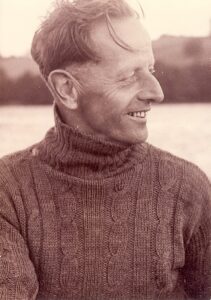
Gerald Swain Pinsent: 1904 – 1993 GRO0366 (Wine and Spirit Merchant, Totnes, Maidenhead)
Dorothy James: 1908 – 1986
Married: 1928: Totnes, Devon
Children by Dorothy James:
Margaret Mary Pinsent: 1928 – 2009 (Married Joseph Albert Beaulieu, U. S. Navy, 1947, Newton Abbot)
Family Branch: Devonport
PinsentID: GRO0366
Click here to view close family members
Gerald Swain Pinsent was the younger of William Henry Pinsent’s sons by his wife Minnie Gertrude (née Pearse). He was born in Teignmouth where his parents had tried, unsuccessfully, to set up and run a seaside boarding house. The project failed (William Henry Pinsent) and William was faced with bankruptcy in 1912. One of the reasons he gave for his financial distress was that he had to pay school fees (Exeter and Plymouth Gazette: Friday 16th February 1912). The fact that he had mismanaged the boarding house and had not wanted his father – a well known “brewer” in Newton Abbot – to know of his predicatment was probably also relevant.
It seems likely that William Henry sent his two sons Donovan Henry Douglas Pinsent and Gerald Swain Pinsent to “Wallingbrook School”, in Chumleigh, in North Devon in the mid-1910s and early-1920s. However, I have no direct evidence for his elder son ever being there. The “Pinsent” at “Wallingbrook” between 1921 and 1923 was probably Gerald Swain Pinsent. Donovan would have left by then. The English Private (“Public”) Schools traditionally referred to their boys by their surname alone, and add suffixes such as “Major” and “Minor” if there was more than one of them. In the absence of a suffix, “Pinsent” was probably Gerald. While at “Wallingbrook”, “Pinsent” took an active interest in sport. He played cricket and evidently bowled well—taking eight out of ten wickets in a match against “Barnstaple Grammar School 2nd XI” on one occasion in 1921 (North Devon Journal: Thursday 23rd June 1921).
He also took an active interest in track and field. “Pinsent” came second in the 440 yards race for boys over 14 years at the school sports day in July 1923 (Western Times: Friday 20th July 1923). “Pinsent” seems to have kept up his association with the school as he won the “Old Boys’ 100 yards sprint” (Exeter and Plymouth Gazette: Friday 24th July 1925) two years later, and he came third in the same event the following year (Exeter and Plymouth Gazette: Friday 23rd July 1926). He kept coming back! In July 1933, “Pinsent” won both the 100 yards and 220 yards sprints (Western Times: Friday July 21st, 1933). Gerald Pinsent was an active member of the “Paignton Amateur Athletic Club” – which may account for his continued success – and for my conviction that the “old boy” is, in fact, Gerald. Gerald evidently specialized in track and field and he did well in the 100 yards handicap, the 220 yards handicap, and the 220 yards hurdles at a sports day held in conjunction with the “Paignton Lifeboat Day Celebration” (Western Morning News: Thursday 9th August 1928). Similarly, he came in second in the final of the 220 yards “open” handicap at the “Babbacombe Sports Meet” when it was run the following year (Exeter and Plymouth Gazette: Monday 12th August 1929). He also won the Men’s Hurdles at the Paignton Club’s home event in September that year (Torbay Express and South Devon Echo: Thursday 12th September 1929). In the early 1950s, The Paignton Observer and Echo ran a segment with clipping “from the Paignton Observer of 25 years ago.” Gerald must have been amused to see the results from his races in 1928 and 1929 come back to haunt him – as they did on 24th September 1954 and 15th July 1954 (and other dates).
Gerald represented the “Paignton Club” in 100 yards and 220 yards, “open” handicap races at events held in Harberton, Torquay, Exeter and Brixham the following year, in 1930. He came in first in the former and third in the latter at Brixham (Exeter and Plymouth Gazette: Tuesday 26th August 1930). In 1931, it was a similar story, as it was also, although to a lesser extent, in 1932. That year, he won the 440 yards “open” handicap in Paignton (Western Morning News: Thursday 14th July 1932).
Gerald Swain Pinsent probably played soccer (“football”) for the “Paignton Rovers” while living in Paignton in the mid-1920s. However, it was actually “Pincent” who took to the pitch (Western Morning News: Wednesday 17th February 1926). Oddly enough, his daughter was later to acknowledge this alternative spelling. Nevertheless, Gerald’s later and most enduring interests seems to have been tennis and golf. He played both singles and doubles tennis matches competitively from 1937 through to at least 1950. In 1937, he partnered with J. Harvey to win the “Men’s Double Handicap” at the “Teignmouth Tennis (Hard Court) Tournament” (Western Morning News: Thursday 10th July 1937). From then on, at least up to the start of the war, he entered both men’s single and also mens’ doubles and mixed doubles competitions on a fairly regular basis – doing well in some and less well in others. In the winter months, he threw in the odd game of squash as well (Western Morning News: Tuesday 13th December 1938).
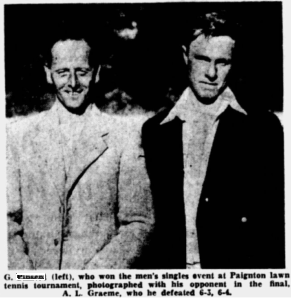
After the war, Gerald returned to tournament play and his name crops up fairly frequently in descriptions of match results. The Torquay Times and South Devon Advertiser (Friday 8th June 1951) noted the presence of two “prominent local players , C. E. Ware and G. Pinsent” when the “Paignton Lawn Tennis Tournament” was held in 1951, and the Torbay Express and South Devon Echo (Monday 18th June 1951) tells us that Gerald won the singles event and says that “Pinsent played very steadily and seemed to be the complete master of the conditions and of the ball. The final was less of a battle and Pinsent was a worthy winner …”. For some reason, he stopped playing competitive tennis the following year and his retirement was deemed worthy of note (Torbay Express and South Devon Echo: Monday 9th June 1952).
Gerald had played squash to keep his eye in and occasionally represented the “Torquay Imperial Squash Rackets Club” (Western Morning News: Thursday 17th April 1947), and if that were not enough, he played golf at the “Newton Abbot Golf Club” (Western Morning News: Thursday 31st March 1949) and later at the “Churston Golf Club” in Paignton. He played well and won the Churston Club’s “Presidents Cup” in 1958 (Paignton Observer and Echo: 11th December 1958). He was still playing in 1962.
Gerald Swain Pinsent was a “clerk” for a wine and spirit merchant when he married Dorothy James, in June 1928. He may have been either living or visiting with his father at “Riverside Bungalow” on the Ashburton Road, in Totnes at the time. Gerald and Dorothy had a daughter, Margaret Mary Pinsent in October that year.
Margaret had a different take on physical activity. She studied dance under Miss Hazel Hexter (M.I.S.T.) at the Hazlemere School of Dancing in Paignton, and was one of the younger members when her pupils gave “a really splendid display of classical dancing” in 1938 (Paignton Observer and Echo: 18th May 1938). This was one of many performances that Miss Hexter’s pupils gave prior to, during and after the war. Margaret achieved Grade III at the Spring Session of the Royal Academy of Dance examinations in May 1941 and featured in another performance the pupils gave in August 1941 (Paignton Observer and Echo: 29th May & 14th August 1941). She was. awarded a Grade V (Higher Division) certificate with honours in 1943 and achieved full certification in September. 1945 (Paignton Observer and Echo: 27th May 1943 & 27th September 1945).
Hazel Hexter, the principal of the Hazlemere School of Dancing, took on two of her erstwhile students, Nancy Dodd and Margaret Pincent (sic) as assistants the following spring. Margaret taught at the school and performed through to at least May 1947 (Paignton Observer and Echo: 29th May 1947).
Margaret left Paignton around then. She married a United States Serviceman, Joseph Albert Beaulieu [SKD3, U.S. Navy, No. 7518214] in 1947 and emigrated to the United States as a “war bride”. Gerald and Dorothy went out to see her in 1949. Embarkation records show that they left for New York on the “Cunard White Star Liner Queen Elizabeth” on 2nd December 1949 and returned a few weeks later. They went out again in 1954, and 1956, perhaps to inspect grandchildren (?). Gerald and Dorothy had no other children of their own – that I am aware of.
Gerald Swain and his wife lived in Paignton but attended the “Dart Vale Harriers Hunt Ball” in Totnes, in January 1929 (Western Times: Friday 11th January 1929). Gerald was back in Totnes a couple of months later visiting his father, and was present when the latter had his laundry stolen (see William Henry Pinsent)! Apparently, his father had given a vagrant permission to sleep in his barn and he had taken off with a bag of laundry that William had left collection. The vagrant sold the clothes to a woman who turned him in to the police (Western Times: Friday 15th March 1929).
Gerald had met the magistrates a few years earlier. Gerald (then of “Woodcot, Morin Road”, in Paignton) had, unfortunately, knocked over an aristocratic Dutch visitor (Baroness Van der Werff) while riding his firm’s motorcycle through Torquay. The car in front of him had slowed down to allow a couple of pedestrians to cross the road ahead of it – so that they could catch a tram that was going in the other direction – and Gerald had misread the situation. He had tried to overtake by cutting through between the car and the tram — and had collided with the Baroness. He was charged with dangerous driving, although he claimed to have being going at no more than 12 and 15 miles per hour. His lawyer suggested that “the law had too long been inclined to regard the pedestrian as always being in the right and the motorist in the wrong. In that case the defendant had been taken by surprise. His vision was obscured by the motor-car, and the fact that he pulled up in two or three yards showed that he was not travelling at an excessive speed” (Torquay Times, and South Devon Advertiser: Friday 29th July 1926). The magistrates, nevertheless, fined him 40s and asked for £3 10s in costs for damage to the tram, and they endorsed his license (Western Morning News: Tuesday 6th July 1926). One has to wonder if the status of the victim – who does not seem to have been hurt – influenced the magistrates.
Gerald was living on Tarraway Road in Paignton when called to give evidence at a “Coroner’s Inquest” in Ashburton in June 1929. The Newspapers tell us that he had been a passenger in a car that had (the misfortune – you should try it!) of following two lorries (trucks) along a narrow Devon road. His colleague, who was driving, testified that they were so incensed that one of the lorry drivers appeared to be drunk that they stopped the car when passing through Buckfastleigh and told a policeman about it. The constable joined them in the car and they drove off after the lorries. They caught up with them at the “Half Moon Inn” near Ashburton and saw the second lorry crash into the back end of the first, which was, by then, parked. Unfortunately, its driver had been standing behind his vehicle and he had been killed in the crash. The inebriated driver of the second lorry had killed the sober driver of the first! For some reason, the “Coroner” called it an “Accidental Death” (Western Times: Friday 28th June 1929).
Gerald had another brush with the powers-that-be during the early months of the war when he fell afoul of some recently imposed blackout regulations while living in Newton Abbot running an “Off-Licence” at 103 Queen Street (1939 Register). His grandfather would, doubtless, have approved of his profession. Perhaps the outlet had originally been attached to the family brewery. It seems that Gerald failed to notice that there was a light on in a room when he left his house and he had not got back in time to turn it off. P.C. Holland made a note of the infraction and dutifully entered the house by means of a ladder to turn of the light. Gerald was fined 10s (Torbay Express and South Devon Echo: Tuesday 17th October 1939).
Gerald later became a “wine and spirit merchant” in Dartmouth (?). Gerald and Dorothy lived in Dittisham, and then in Brixham in the 1950s and early 1960s. However, it seems likely that they moved up to Ruislip, near London, to be near their daughter, Margaret, who had returned to England with her familly. The Electoral Registers show that Gerald and Dorothy were living on Ickenham Close in Ruislip in 1964 and 1965. Sadly, Margaret’s young son Gerald Albert Beaulieu, an American by birth aged 13 years old, died there in 1967.
The couple finally settling in Maidenhead, in Berkshire, in 1968. Dorothy Pinsent died there in 1986 and Gerald returned to Devon. He was back living in the Torbay area when he died in 1993.
Family Tree
Grandparents
Grandfather: William Swain Pinsent: 1843 – 1920
Grandmother: Harriet Eliza Cookson: 1846 – 1892
Parents
Father: William Henry Pinsent: 1874 – 1949
Mother: Minnie Gertrude Pearse: 1872 – 1937
Father’s Siblings (Aunts, Uncles)
John Douglas Pinsent: 1872 – 1936
William Henry Pinsent: 1874 – 1949 ✔️
Male Siblings (Brothers)
Henry Douglas Pinsent: 1897 – 1897
Donovan Henry Douglas Pinsent: 1901 – 1980
Gerald Swain Pinsent: 1904 – 1993 ✔️
Please use the above links to explore this branch of the family tree. The default “Next” and “Previous” links below may lead to other unrelated branches.