Vital Statistics
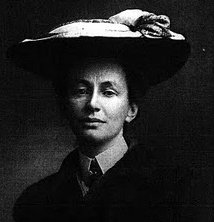
Ellen Frances Pinsent (née Ellen Frances Parker): 1866 – 1949 GRO0245
Hume Chancellor Pinsent: 1857 – 1920 (Solicitor, Birmingham, Warwickshire)
Married: 1888
Family Branch: Devonport
PinsentID: GRO0245
Hume Chancellor Pinsent’s wife, Ellen Frances Pinsent (née Parker) was an important figure in her own right. She was the daughter of the Rector of Claxy in Lincolnshire (Birmingham Daily Post: 30th July 1888) and had at least one brother, Robert John Parker. He was a friend of Hume’s at Cambridge and went on to become a successful lawyer and a Judge of the “Appeal Court.” He was later to become a peer of the realm – Baron Parker of Waddington.
According to Daniel J. Kevles (“In the Name of Eugenics”: 1985), Hume Chancellor, Robert John Parker and his sister Ellen Frances Parker were members of the “Men and Women’s Club” in Cambridge. The organization had been founded by a friend of the Parkers’, Karl Pearson, who was, himself, a brilliant mathematician. Karl studied law but his principal claim to fame came through the application of statistics to the Dalton’s newly established field of “eugenics”. Interestingly, Karl seems to have been was none too pleased when Ellen became engaged to Hume! He is reported to have said: “I suppose Miss Parker will now devote herself to housekeeping and possibly the piano. She might have done excellent work, if she had had the ordeal of getting her own living by some profession for a few years, instead of passing from home to home.” He had yet to marry: perhaps he was bit jealous. Either that – or he seriously underestimated Ellen’s competence and capability.
Ellen had developed a keen understanding of rural life around her home village in Lincolnshire and as a young housewife she wrote four well received novels that hark back to her early days in Lincolnshire. “Swan Sonenschiein and Co.” published “Jenny’s Case” in 1892. It describes the life of a young girl living in just such a world who was almost foredoomed to later misfortune (Morning Post: 17th September 1982). According to a review in the National Observer (Saturday 24th September 1892), Ellen was “to be congratulated upon the first fruits of her endeavour” for producing “an honest and satisfactory piece of work.” Her next work, “Children of this World” was published by “Methuen and Co.” in 1895. It too was also well received (Birmingham Daily Gazette: Friday 29th March 1895). In it, she describes the different lives and attitudes of two young women, Rachel (pious and religious) and Janet (decidedly less so). As the book would have it, the former falls in love with a married man and eventually commits suicide and the latter marries for money and a title but finds very little satisfaction in it (Freeman’s Journal: 20th May 1895). “No Place for Repentance”, her third book, was published by “T. Fisher Unwin” in 1896. It is about the evil caused by drink in a small village in the Lincolnshire Fens and the last, “Job Hildred Artist & Carpenter” (published by “E. Arnold” in 1897) is about a lady whose smothering patronage of a carpenter’s artistic son leads to his eventual rebellion, his return to normal village life, and his mental collapse. Her books were well reviewed. However, she was, by one account at least, “overly wordy” (Guardian: December 1st 1897).
I cannot claim to have read any of her books. A correspondent to the Harborne Herald (Saturday 7th January 1893) concluded that they were not meant to be read! “I do not intend to give any pain to Mrs. Pinsent, whom residence is, I believe, on Wellington Road, but it is by means of her book that I have discovered that books are sometimes never intended to be read by the borrowers. I have taken out Mrs. “Jenny’s Case” a book which has been favoured with the highest praise in the literary world. It has been taken out of the library four times, once on the 19th of December, once on the 28th, and twice on January 2nd. When I came to look through it, I found that even so early as page 30 two of the leaves had not been cut, and the similar evidence in more than a dozen places throughout the book show that it had not been read. So we see that the number of times a book is borrowed does not necessarily mean that it is read by the public”. Harsh, but … The Harborne Herald was, nevertheless, highly complimentary about her work: “A Harborne Authoress: Amid the tons of veritable rubbish that teems from the press under the name of literature, it is consoling to find now and again a work really worthy of being classed as such, and those who turn to the “Children of this world,” just issued by Messrs. Methuen and Co., may have every confidence of being able to peruse it without disappointment. This is the second published work of Mrs. Ellen Pinsent, a well-known resident of Harborne; and the popularity she achieved in “Jenny’s Case,” published some two years ago, will be considerably enhanced by her present venture” (Harborne Herald: Saturday 6th April 1895). Presumably the critic had made a better job of cutting the pages.
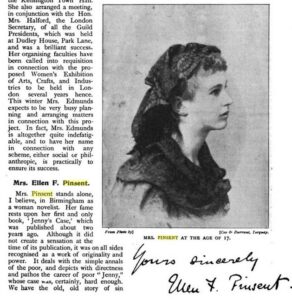
Ellen was soon to be honoured as one of the “Ladies of Birmingham” and the Birmingham Daily Post (Wednesday 23rd January 1895) interviewed her for a series it ran called “Women at Home.” With it, the paper published a flattering photograph of Ellen as she had been at age seventeen!
If there is a common theme in her books it seems to be mental health – an interest the Ellen Frances carried into later life. Ellen was “Hon. Secretary” of “The Society for the Prevention of Cruelty to Children” in the early 1890s, and gave a talk entitled “Our Neglected Children, and the Society for their Protection” to the “Birmingham and Midland’s Women’s Liberal Unionist Association” in December 1893. In it, she stressed that the Society worked with parents and only solicited the help of law enforcement as a last resort (Birmingham Daily Post: 6th December 1893). The following year, she gave a lecture entitled “The Limitation by Law of the Hours of Labour” and discussed the benefits to be had from Mr. (Neville) Chamberlain’s proposed legislation to limit hours of work (Birmingham Daily Post: 7th December 1894).
In 1900, Mrs. Hume Pinsent was appointed to Birmingham’s “Special Schools Sub-committee” (Birmingham Daily Post: 30th June 1900). This was her introduction to civic politics. Every year, she presented a report to the City’s Education Committee that pushed for more resources for the disabled. In 1909, she lobbied for day schools for the blind (Birmingham Mail: Friday 26th February 1909) and recommended “evening classes in lip-reading at the Pupil Teachers Centre in Oozels Street” (Birmingham Mail Friday 16th July 1909). It was clear that she needed to be heard on the City’s “Attendance, Finance and General Committee” and in November that year one of the members stepped down to make space for her (Birmingham Mail: Wednesday 10th November 1909).
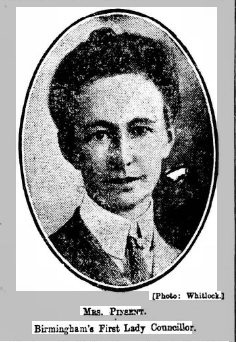
In 1911 she became the first woman ever elected to “Birmingham City Council”. Ellen was active in city affairs until she retired in August 1913 and moved to Oxford with her husband, Hume Chancellor (Birmingham Mail: Saturday 9th August 1913). While on Council, Ellen argued that children under the age of five from the city’s poorer districts would benefit from at least half a day at school, but the “Board of Education” was predictably parsimonious and would have none of it (Birmingham Mail: Friday 30th May 1913). One of Ellen’s last battles was a fight over the pay of “Special School Teachers.” As she put it, now the “committee had swallowed the camel, [presumably acknowledging the need for them: RHP] they would not now object to the gnat [of paying for them: RHP]” (Birmingham Mail: Friday 24th January 1913). After moving to Oxford, she accepted an honorary position on the “National Board of Control” that oversaw the care of the mentally challenged.
Meanwhile, back in 1904, Mrs. Pinsent lobbied hard that a recommendation, that councils make adequate provision for defective and epileptic children be written into the “Elementary Education of Defective and Epileptic Children Act,” and that the requirement be made compulsory (Birmingham Daily Gazette: Saturday 30th April 1904). She pointed out the absurdity of making such a provision voluntary. Given her high profile and passion for the subject; it must have seemed natural to appoint her to a “Royal Commission” (established by King Edward VI) “to consider the existing methods of dealing with idiots and epileptics, and with imbecile, feeble-minded, or defective persons not certified under the Lunacy Laws” (Daily Telegraph & Courier (London): Thursday 1st September 1904). It was to report back as soon as possible.
The debate was now on: Ellen Frances traveled the country and gave numerous talks about the role of the “Commission” and of her experiences with the “Special Schools” programme in Birmingham (Sheffield Daily Telegraph: October 15th 1904). The City Council was toying with the idea of building a custom boarding school for defective children in Kenilworth – but had yet to commit to the idea (Kenilworth Advertiser: Saturday 4th March 1905).
In 1905, the “Commission” sailed to New York to visit American asylums and see how they were handling the problem (Liverpool Daily Post: September 27th 1905). Before going, Ellen Frances attempted to persuade “Birmingham City Council” to get ahead of the issue by building two dedicated boarding schools for feeble-minded children, and not wait for the commission’s report. She argued that in the long run, it would be far cheaper than following the current, highly inefficient, set of programmes as they saw far too many people land up in workhouses, lunatic asylums and prisons. Her speech was well received; however, even though the “City Guardians” supported her proposal, “City Council” balked at the cost and decided to defer the matter (Birmingham Daily Gazette: Saturday 25th February 1905).
The “Royal Commission” handed in its report in 1906 and the King established a new “Commission” with a somewhat broader mandate. This time, it was asked to come up with recommendations “due regard being had to the expense involved in any such proposals and to the best means of securing economy therein; and also to inquire into the constitution, jurisdiction, and working of the Commission in Lunacy and of other Lunacy Authorities in England and Wales, and into the expediency of amending the same or adopting some other system of supervising the care of lunatics and mental defectives and to report as to any amendments in the law which should, in your opinion, be adopted”. Ellen Frances was appointed to the Commission and, once again, took to the lecture circuit.
There was a limit to how much the Government was prepared to pay for social programmes. However, she made progress – at least in the Midlands, in part by contributing some of her own money. She gave £50 to a fund to provide loans for teachers attending college (Birmingham Mail: Friday 29th June 1906). The following year “Birmingham City Council” bought “Sandwell Hall” an old mansion near West Bromwich and converted it into an institution for the training and permanent care of the mentally defective (Birmingham Daily Gazette: Friday 4th October, 1907). Ellen must have been pleased to to be able to advertiser for a residential “Assistant Mistress” for the place (Birmingham Mail: Saturday 11th May 1907). “Sandwell” was a start, but it was far too small and the following March Ellen lobbied to increase its capacity from 20 to 60 people. Needless to say, any discussion of capital expenditure met with resistance but the Council agreed that another ten children could, perhaps, be accommodated (Birmingham Mail: Friday 27th March 1908).
Later that year (1908) Mrs. Pinsent who was, of course, by then a member of the Commission looking into the care of the feeble-minded, presented a report on the issue to Birmingham City Council. It responded that it “approved generally of the recommendations” … and suggested the “Council to pass resolutions to that effect” (Birmingham Mail: Thursday 24th December 1908): Progress.
In Gloucester, she described what was happening in Birmingham and explained, how, in some cases some people might have to be housed in colonies: “In Birmingham it had been found that the only feasible plan for exercising adequate supervision was by collecting all the worst cases together in a resident colony, for the following reasons: — 1) To enable them to contribute to their own support: (2) to save them from vicious habits; (3) to save them from harsh treatment at home and in the streets; (4) to prevent them becoming drunkards, criminals, and prostitutes: (5) to prevent them giving birth to children who would only further burden the community” (Gloucestershire Echo: 11th December 1907).
Much of the work being done in mental health was by unpaid volunteers and in June 1908, at a meeting of “Birmingham Council,” Ellen spoke of the excellent services provided by the City’s “After-Care Sub-committee.” She remarked that “the magnitude of that voluntary work might be gathered when she said that there were 535 individual cases, each of which was visited three times a year” (Birmingham Daily Gazette: Saturday 27th June 1908). At the same time, she remarked that “out of 308 feeble-minded persons who left school, only 19.8 per cent were earning wages at all, and only 3.9 percent were earning as much as 10s a week” (Birmingham Mail: Friday 26th June 1908).
Although Ellen Frances and countless other women ran many of the social services in Birmingham – and elsewhere for that matter – as volunteers, they had very little input into public policy as there was a quirk in the law that prevented married women from running for office. You had to be on the electoral rolls, which implied property ownership -which few married women then had as “their” property was usually in their husbands name. The result was that very few women made it into positions of authority on County or City Councils (Birmingham Daily Gazette: Wednesday 24th March 1909).
Ellen was fortunate in that she was on the electoral roll and Birmingham was exceptionally liberal in its interpretation of the various inconsistencies in the law (London Evening Standard: Friday 20th September 1912). She was elected the first woman member of “Birmingham City Council” in 1911.
Ellen discussed one of the main recommendations of the “Commission” at a meeting in Cambridge in 1909. It was that the care of the feeble-minded should stay the responsibility of “County Councils” but the councils themselves should report to a central “Board of Control.” Mrs. Hume Pinsent provided statistics suggesting that almost one percent of the population qualified as mentally defective (at least to some degree or other). She noted that these unfortunate individuals were a cost to society and that the current ways of handling were not only expensive but also inefficient and often ineffectual.
She said a new “Act of Parliament” was required to provide unity of control and continuity of care. The underlying principal was that those who could not take part in the struggle of life should be granted the level of state protection appropriate to their need. She recommended strengthening the current “Lunacy Commission” into a “Board of Control” and making it responsible for eight regional districts. She also said that “County Councils” should take responsible for providing the necessary services, and added that they might have to set up committees to act as guardians for children under the age of 21, and ensure the continuity of their care (Cambridge Independent Press: 12th March 1909). She gave similar talks elsewhere around the country (Birmingham Mail: Tuesday 8th June 1909).
Ellen was part of a delegation sent to lobby the Prime Minister regarding the legislation in July 1910 (Birmingham Mail: 15th July 1910). She said it was needed as there was still considerable public and bureaucratic inertia to be overcome. As the Birmingham Mail (Saturday 26th June 1909) put it: “despite the indefatigable labours of Mrs. Pinsent, to which such activity as the (Birmingham) Committee has shown on behalf of this section of the community is due, the public has failed so far to realize adequately the seriousness of the problem which this class presents, and the grave need that exists.”
In February 1910, Mrs. Hume Pinsent gave an alarming talk in Leeds on the issue of hereditary “suicidal mania”. In it, she discussed a case from the “Mendel Journal” (The Organ of the Mendel Society) and went into considerable detail about two families from a single village that suffered from a seemingly hereditary suicidal condition: apparently one favoured drowning and the other shooting. Predictably, the condition only got worse when the families intermarried … (Evening Express: 12th February 1910). Whether the report was based on fact or fiction (“alternative facts”) I don’t know, but Ellen Frances and others clearly believed it. She was a member of “Eugenics Society” and she was on its “Council” in 1911. Ellen was also on the “Committee of the First International Eugenics Congress” in 1912, so she clearly believed heredity was a contributing factor – and probably had ever since her time at University.
In April 1910, Mrs. Pinsent gave a talk on “The Perils of Altruism” at a meeting of the “Haslemere Eugenics Club” (London Times: 4th April 1910) and presented the same material at the “Annual Church Congress” in Cambridge that year. She complained about the injustice in the current system of handling mentally defectives and she went into the life-histories of several families over three or four generations. She then discussed the (financial) costs that more “efficient citizens” incurred in looking after these families (London Times: 29th September 1910). The talk was well covered by the press and she followed it up with similar talks all over the country. If she intended to shock her audience in Sheffield the following month she probably succeeded with a talk entitled “Unfit Parents: Lecture on the Care of Defectives: Breeding Criminals” (Long Eaton Advertiser: Friday 6th May 1910). In it, she discussed the “appalling folly and social tragedy of England’s neglect of the feeble minded …”.
The issue of heredity was fully aired. At the session devoted to “Heredity and Social Responsibility” at the “Church Congress” Mrs. Pinsent pointed out that “the undesirable classes of the population were fast increasing and (she) argued that the desirable and efficient members of society must be encouraged to have large families and that there should be direct State encouragement for the reproduction of better stocks …” (Lincolnshire Echo: 28th September 1910). These ideas were not considered particularly contentious in those days. Although there was a genuine concern about the welfare of the mentally challenged- there was also some concern about the number of able-bodied men and women who were emigrating in search of a better life elsewhere. In those days, even the Bishops were worried!
Mrs. Hume Pinsent promoted the findings of the “Royal Commission” in an article (“Our Provision for the Mentally Defective”) in the “Nineteenth Century” – which was a widely read topical magazine. She noted that there were well over a quarter of a million people in England and Wales who qualified as mentally defective and said they should be handled in a more integrated manner. She made the case for segregation of the worst cases, saying: “We want to prevent, the birth of such people (the feeble-minded), and continuous segregation of the mentally defective is the chief means of doing so. It appears that the birth-rate among defectives is unusually high, and though the death rate is also high, there can be no doubt that the number of degenerate survivors is large” (The Worker: New South Wales: 15th September 1910). Elsewhere, in a review of the “Nineteenth Century” article, we find: “Mrs. Pinsent advocated the segregation of the unfit. She observed that the altruism of the 19th and 20th centuries was lowering the general standard of humanity. The lowest types were tended, the higher neglected. Mrs. Pinsent illustrated her argument from the histories of mentally defective families in which mental defects and criminal propensities could be traced through three or four generations. The cost of such families to the community was very large. Fourteen individuals in one family had been supported at public expense in industrial schools, reformatories, workhouses, asylums, and homes. They passed continually from one of these institutions to another, with short intervals of liberty, during which they reproduced their kind” (The Mercury: Tasmania: 3rd November 1910). Clearly, she thought the only sensible thing to do was to keep the mentally challenged in sexually segregated Asylums or colonies. She was not alone in this: Winston Churchill, “Home Secretary” in the Asquith government, told a delegation from Mrs. Pinsent’s association (“Association for the Care of the Feebleminded”) that, while the thousands of feeble-minded in Britain deserved “all that could be done for them by a Christian and scientific civilization now that they were in the world,” they should, if possible, be “segregated under proper conditions [so] that their curse died with them and was not transmitted to future generations” (In the Name of Eugenics: D. J. Kevles).
Not everyone liked the idea of state intervention. As a reviewer for the Edinburgh Evening News (Tuesday 26th July 1910) noted: “Some students of eugenics, however, are too impatient to wait for the natural extinction. They claim for the State the right to decide that certain types shall not survive, or at least shall not perpetuate themselves.” The Government was therefore galvanized into action based on the twin arguments of cost and heredity.
Ellen traveled extensively and turned up as a guest speaker at meetings all over the country. For instance, she gave an address at the “Torquay Charity Organization Society Annual General Meeting” in April 1911 (Torquay Times, and South Devon Advertiser: Friday 21st April 1911). This was shortly before a meeting in the Town Hall in Colchester that she attended after a tour of the “Eastern Counties’ Asylum” that May. While there, Mrs. Pinsent said that there were two categories of mentally defective people: those that “acquired” insanity/dementia during life, and those that were just born with feeble minds. It was clear that both classes were disproportionately responsible for such crimes as drunkenness and arson but, she said, it was a mistake to keep them in the prison system. Again, she advocated for colonies and asylums’ such as the one she had just visited. However, she cautioned against “our method of breeding paupers” saying that in one Workhouse “there had been found 18 mentally defective women who had produced 93 illegitimate children” (Chelmsford Chronicle: 5th May 1911). Her ideas spread and when a Mrs. Pearce Clark lectured the Christian Social Union in Tunbridge Wells in March 1911, she quoted Mrs. Pinsent as saying: “A feeble-minded mother with little children is one of the most appalling sights of our modern civilization.” It probably was, but was segregation the answer?
One of Ellen’s most effective arguments to Government was that of economy. A considerable amount of money was already being spent on the mentally and physically handicapped up to the age of sixteen, but from then on there was nothing. They were on their own and they became a burden on the state in other ways (Birmingham Daily Gazette: Saturday 25th June 1910).
This last point was not lost on the “Guardians” responsible for the “Birmingham City Workhouse” at “Monyhull”. According to Mrs. Hume Pinsent, they were one of the most enlightened boards in England and they did what they could to provide adequate provision for defectives (Birmingham Daily Gazette: Friday 9th December 1910). There was considerable discussion about adding a children’s department the following year, so that the inmates could progress directly from one kind of care to another (Birmingham Daily Gazette: Saturday 28th January 1911). In May 1912, Ellen presented the City with a report “based on ten years of investigation” that recommended adding accommodation for epileptic and mentally defective children to the existing establishment at Monyhull (Birmingham Mail: Friday 24th May 1912). There were grumbles in the press, of course: “If the ratepayers only knew the money positively thrown away on what are called special schools and classes which Mrs. Pinsent seems to have sole charge of, there would be short shift made of the majority of that committee. But so long as the public will allow the councillors to be elected on party lines they must put up with the burdens – Yours, Etc., June 16: Tired of Party Politics” (Birmingham Mail: Tuesday 18th June 1912). She, of course, argued that it was a cost effective way of dealing with an issue that was not going to go away (Birmingham May: Friday 19th July 1912).
The matter came to a head, and the call for legislation was picked up around the country. Ellen gave an impressive speech at the “Women’s National Liberal Association’s” Conference in London in May 1913 (London Daily News: Wednesday 28th May 1913). Evidently, “Mrs. Pinsent produced the appallingly red chart of the life of a feeble-minded woman who has been convicted over 200 times, generally of being drunk and disorderly: [Stupid Punishment] Her liberty has been somewhat interfered with”, Mrs. Pinsent remarked, “in a manner that is of absolutely no good to her or to the community. When we get the Bill through, we shall be able to stop this stupid punishment of the feebleminded”.
The government introduced the “Mental Deficiency Act” in Parliament in May 1912 and after considerable lobbying it passed into law the following year. Fortunately, Josiah Wedgewood and others had managed to soften the more extreme aspects of the bill. For instance, “it made the test of such deficiency, and of the need for care, not heredity but social incapacity — an inability to look after oneself. It also provided the possibility for many victims of mental deficiency, even while under care and control, to live in the outside community rather than in institutions. The law, in short, did not impose mandatory segregation of all mentally handicapped people to prevent their reproducing themselves, and there was no mention of sterilization ” (In the name of Eugenics: D. J. Kevles).
Ellen Frances developed a considerable profile in the press during the long debate that preceded the “Mental Deficiency Act” and she ran for “City Council” as a “Liberal Unionist” in Edgbaston Ward in November 1911. That she was able to run at all was a function of a very liberal interpretation of the laws on eligibility! Most married women were disqualified because their husbands owned the family property; however Ellen’s name was on the electoral roll and she was allowed to run. She was elected easily (Birmingham Daily Gazette: Thursday 2nd November, 1911).
The Government eventually recognized that the lack of female franchise was a problem and it attempted to rectify the it at the Council level with the “Franchise and Registration Bill” in 1913. However, it was so poorly worded that it did more harm than good outside of London (Birmingham Mail: Friday 14th March 1913). The issue of female suffrage wasn’t resolved until after the First World War.
Ellen was, predictably, appointed to the Birmingham’s “Education” and “Asylum” committees and, of course, retained her position as Chair of the “Special Schools Committee.” Ellen Frances Pinsent represented the City at the annual meeting of the “Association of Municipal Corporations” the following year (Hull Daily Mail: 29th May 1912) and repeated her call for legislation to deal with the feeble-minded (Birmingham Mail: Tuesday 14th May 1912). What the other councillors thought of being addressed by a female colleague, I do not know.
Being on the City Council, gave Ellen far more say when it came to financial matters and she voted on a wide variety of issues; however, her principle concerns remained mental health and education. After the passage of the “Mental Deficiency Act” in 1913 there was some improvement in the way mental health issues were handled. The chairman of Birmingham’s “Education Committee” reportedly said that, after studying and discussing the “Act” with Mrs. Pinsent, he concluded that although there was still much that was obscure, the committee’s powers were not overly infringed; however, “certain duties were imposed upon them which were not their duties before” (Birmingham Mail: Friday 26th September 1913). The costs would go up!
There was considerable discussion on “City Council” on how to implement the “Act” and particularly on how to integrate blind, epileptic and mentally challenged children into new and existing institutions (Birmingham Daily Gazette: Saturday 14th December, 1912 etc.). The foundation stone for a new wing at “Monyhull” in November 1913 was eventually laid – after considerable prevarication and concern over cost. While speaking at the ceremony, the “Home Secretary” (Mr. McKenna) announced that Mrs. Pinsent would shortly be joining the “Board of Control” as one of its “Commissioners,” and the “Board” would, ultimately, be responsible for this and other institutions (Birmingham Daily Gazette: Saturday 15th November 1913).
I do not know why Hume and Ellen decided to leave Birmingham and move to Oxford. Hume Chancellor was 57 in 1913 and, until then, an active solicitor at “Pinsent and Co.”. Ellen Frances, meanwhile, was 48 still very much involved in social issues and civic politics. Perhaps she felt she could accomplish more on the national scene. Their contributions to life in Birmingham were recognized and their friends and colleagues subscribed to a presentation that was made to them. The subscribers held a meeting to discuss the matter at the Council House on 23rd October 1913 (Birmingham Mail: Saturday 18th October 1913).
Ellen had been associated with the “Birmingham Education Committee” for many years and the Lord Mayor (Lieutenant Colonel E. Martineau) gave a touching tribute to her work and her valuable contributions to countless committees: “She had given most unwearied care and attention to the work of the Special Schools Committee which at times had seriously affected her health. Mrs. Pinsent threw herself into the work and attracted so much attention that she was appointed a member the. Royal Commission, and in that capacity she traveled abroad, and she had proved a most valuable member of that Commission” (Birmingham Mail: Friday 31st October 1913). Interestingly, it was the Lord Mayor’s sister, Clara Martineau, who replaced Ellen on the City Council (Birmingham Mail: Monday 6th October 1913). She was elected without opposition.
After resigning from Council, Ellen accepted a new position as an Honorary (unpaid) Member of the newly established “Board of Control” (London Gazette; 16th December 1913). In this capacity, she continued to push for social reform, and she was a key speaker at an “International Congress on Social Work” held in London in February 1914 (Kenilworth Advertiser: Friday 14th February 1914).
Part of Mrs. Hume Pinsent’s job was to visit and inspected institutions on behalf of the Board – for instance she went to Knowle in Warwickshire in May 1914 – where she again worried out loud about emigration sapping the life-blood of the country (Leamington Spa Courier; 29th May 1914). Sadly, the “First World War” was about to start and she was soon to have other issues to deal with. Not the least of which were the loss of her two sons, Richard Parker Pinsent and David Hume Pinsent. Their lives are discussed elsewhere.
Ellen continued her round of “Workhouse” visits and one can feel the sense of relief experienced by the “Poor Law Guardians” of houses that passed inspection. The Uxbridge & West Drayton Gazette (Friday 1st January 1915) could not resist quoting her report in length: “There are five certified women in this Workhouse. They all seemed very well and happy and were clean and nicely dressed. They were usefully employed in the laundry and in housework. The beds, dayrooms, dormitories etc. were clean and in good order, in fact everything in this Workhouse is exceptionally bright and cheerful. I saw the women at dinner. The dinner was good, plentiful and nicely served. The Matron who evidently takes a great interest in the mentally defective, pointed me out the cases.”
Mrs. Pinsent continued to make tours of inspection around the country throughout the war and most of the workhouses she visited improved their standard of care and, eventually, received good, if not glowing reports. When she visited Coventry to check on its “Workhouse” in 1916 she met with its “Board of Guardians” and they must have been relieved to hear that she felt that everything was in order (Coventry Evening Telegraph: October 11th 1916).
In September 1916 she was appointed to a committee formed to look into the problem of excessive drinking by women in Birmingham (Birmingham Daily Post: 2nd September 1916). This was clearly an issue as, after the war, the Chairman of a completely different Committee (formed to look into the deleterious effects of alcohol) pointed out that the medical investigator assigned to the “Royal Commission on the Care and Control of the Feeble-Minded” believed that 41.6 percent of the defective children that he and Mrs. Pinsent had identified in Birmingham had alcoholic parents (Burnley News: 23rd October 1918).
Ellen Frances visited “Meriden Workhouse” in December 1916 and seemed satisfied (Kenilworth Advertiser: Saturday 2nd December 1916). She went to “Litchfield Workhouse” the following March, and to the “Cambridge Workhouse” in April 1917. At the latter, she felt there was still an urgent need to improve the care of some of the inmates as nothing seemed to have been done to improve their lot over the past summer (Cambridge Independent Press: September 7th 1917). Ellen was kept busy. She visited “Starcross Workhouse” in Devon, in 1916 and again in 1917. Progress was evidently being made. Mrs. Pinsent found that, when it came to training, improvements were being made at “Midland Counties Institute” – despite the limitations on staff and material caused by the war (Kenilworth Advertiser: Saturday 8th December 1917).
In 1887, the more enlightened women in England formed what was later to become the “National Union of Women Workers”. Ellen was elected “President” of the Birmingham Branch in 1897 and again in 1909, and she was active in women’s issues and civic politics while at the same time bringing up her children and writing novels.
Ellen Frances probably supported “Womens Suffrage” but she tried to appear neutral on the issue and did not always succeed. A correspondent to the Birmingham Mail wrote: “Surely it cannot be correct, as reported the “Mail,” that Councillor Mrs. Hume-Pinsent is presiding at an anti-suffrage meeting, and that she is opposed to votes for women. Where is the consistency? Is it possible that in her opinion women may vote for councillors but are not able use the Parliamentary vote properly?” She saw the problem and re-considered the invitation to chair the offending meeting – which was at a Women’s Conference on an (upcoming) “Insurance Bill” that was being sponsored by the “National League for Opposing Women’s Suffrage” (Birmingham Mail: Monday 27th November 1911). She accepted that to chair the meeting “might mislead the public as to her attitude upon the controversial question of woman suffrage.” Still, in November 1916, Ellen Frances and many others signed an open letter stating that they (as female opponents of Women’s Suffrage) felt that the issue of “National Female Suffrage” should be left in abeyance until after the war (Newcastle Journal: November 18th 1916). Her position on the issue is, thus, surprisingly unclear.
Mrs. Hume Pinsent continued her work with the “Board of Control” (Lunacy and Mental Deficiency) throughout the war and in 1919 she received an Honorary Degree (M.A.) from “Birmingham University” for her efforts. Her husband, Hume Chancellor died soon after. Nevertheless, Ellen Frances continued to work for the board and was eventually appointed a permanent (paid!) commissioner in 1921 (Western Daily Press: February 16th 1921).
Ellen moved to “Rough Lee”, Boars Hill, near Oxford around this time, and also purchased a flat at “#8 Chelsea Court, Kensington, London, S.W. 3” for her work in London. She was living there with a cook and a parlour maid when the census takers came calling in 1921! A few years later, in 1928, she moved to “#5 Cumberland House, Kensington Road, London, W. 8 “.
Ellen Frances continued to visit institutions and give talks around the country. For instance, she attended the “5th Annual Meeting of the Staffordshire County Mental Welfare Association” in May 1925, and discussed the role of the board, the requirements of the various acts, and the best methods for serving those in need. She emphasized the need for specialized training and for co-operation between the agencies involved in patient-care (Staffordshire Sentinel: 27th May 1925). By then, she must have been seeing significant improvement in the handling of the needs of the mentally challenged. She was present with the Minister of Health, the Rt. Hon. Neville Chamberlain when Hampshire County Council opened their “Model Home” at Coldeast in Salisbury in 1828 (Hampshire Advertiser: Saturday 4th August 1928).
Mrs. Pinsent became the Board’s “Senior Commissioner” in 1931 and gave one of what must have been her last talks of the subject of “Mental Defects” at the Forum Club at the invitation of the “British Women’s Patriotic League” in May of that year (Reynold’s Newspaper: Sunday 8th March 1931). She retired from Commission at the end of July 1932 (Birmingham Daily Gazette: Tuesday 21st June 1932).
Ellen, nevertheless, remained active and discussed the successes and failures of the “Mental Deficiency Act” and emphasized the need for early diagnosis and better training for the mentally defective in an article published in 1935 (Birmingham Daily Gazette: Friday 12th April 1935). Two years later, she produced a pamphlet entitled “Mental Health Services in Oxford, Oxfordshire and Berkshire” (cost 2/- net) describing the powers held by the local authorities (Reading Standard: Friday 21st May 1937).
Ellen Frances Pinsent was appointed to and was member of the “Feversham Committee on the Voluntary Mental Health Services” between 1936 and 1939 (A Historical Directory of British Women) and was raised to the peerage as a “Dame Commander of the Order of the British Empire” (D.B.E.) in 1937. Perhaps Karl Pearson would have been grudgingly impressed; however, he had died the previous year. At the outset of the “Second World War,” she was found to be a widow, living at “Rough Lee”, Boars Hill, near Oxford with Marianne Cary-Gibson, a “housekeeper – secretary” and with her daughter Hester Agnes Pinsent – who was a “Architectural Assistant” and a member of the “Womens Land Army” (1939 Register).
Dame Ellen Frances Pinsent died suddenly on 10th October 1949 (The Times: October 12th 1949). Her funeral at Wootton, Berkshire, on 14th October was well attended by her extended family. Sir Roy and Lady Pinsent, Christopher Pinsent, Basil Pinsent and Cecil Pinsent (The Times: October 15th 1949) were all in attendance (their lives are discussed elsewhere). Ellen’s obituary in the London Times (21st October, 1948) states “No woman in the country surpasses her in knowledge and experience of mental defect in all its aspects, and the steady development of the colony system owes its inspiration in main to her enthusiasm and devoted and indefatigable labour.”
In the same paper, a friend, Dr. Gilbert Murray, O.M., wrote that she “was a friend to rich and poor, learned and unlearned, to the children and the over-eighties: all could find in her house welcome and sympathy, held if needed and lively discussion of all subjects”. He added that “one of the most remarkable sights (at her funeral at Wootton) was a great cross of flowers made up by the little bunches picked, on their own initiative, by the children of the village school.”
Ellen Frances Pinsent has not been entirely forgotten. There are numerous articles and online references to her – including a paper entitled “Ellen Pinsent: Including the “Feebleminded” in Birmingham, 1900-1913” (https://eric.ed.gov/?id=EJ719672) by Anna Brown. I admit have not read it thoroughly.
In 1961, Dame Ellen’s daughter Lady Adrian, the wife of the “Master” of “Trinity College” in Cambridge, returned to Birmingham to open a new school for handicapped children. “The Dame Ellen Pinsent Special Primary School” was named in her mother’s honour. While there, Lady Adrian recounted her mother’s favourite story regarding her run for city council in 1911. Apparently, when a friend called on an elderly lady and asked for her vote, she said “I have known Mr. Charles and Mr. Todd (the other candidates) since they were so high and I don’t think much of them. As for Mrs. Pinsent, she only wants to be among a pack of men!” Which was, of course, true. She was the first woman elected to council (Birmingham Daily Post: Tuesday 16th May 1961).
Lady Adrian was Ellen’s daughter Hester Agnes Pinsent. She was born in Birmingham. I do not known much about her early years; however, she attended the seemingly countless family events and was one of two young bride’s maids who attended the wedding of Mr. George Schuster and Mr. Gwendolen Parker in 1909. With her was Miss Mary Parker (a cousin of the bride). There were three slightly older bride’s maids as well – Miss Vivian Parker (the bride’s sister); Miss Evelyn Schuster (the groom’s cousin) and a Miss Ruth Darwin (daughter of Mr. and the Hon. Mrs. Horace Darwin). The wedding was well covered by the press (Gentlewoman: Saturday 2nd January 1909) – although Hester Agnes was called “Heather”.
Hester seems to have spent some time with her Radford cousins, Maisie, Marion and Evelyn (daughters of her Aunt Mary Edith Radford) while growing up. The Radford connection can be explored on-line at “The Radford Sisters Project.” They were all involved in a concert entitled “Songs and Dances of Many Lands” held in London, in March 1922 (Era: Wednesday 1st March 1922). Hester was interested in dance, and she took part in an entertainment put on by the women students at Somerville College in Oxford in 1920 (Oxford Chronicle and Reading Gazette: Friday 19th November 1922). Evidently “the sword dance by Miss Pinsent was very pleasing”. Later that year, she graduated with a 2nd Class Honours Degree in Modern History (Scotsman: 1st August 1922).
She married Edgar Douglas Adrian in Westminster in June 1923. He was a Cambridge graduate and rising “physiologist” who worked with servicemen suffering from nerve damage caused by wartime wounds. Edgar was interested in the effect of electrical impulses on nerve endings and his later work – with Sir Charles Sherrington – earned them both a “Nobel Prize” in 1932. His early studies lead to more sophisticated work on electrical conductivity in the brain and he wrote several books on the subject. Edgar was elected “Master” of “Trinity College” Cambridge in 1951 and “President” of the “Royal Society” between 1950 and 1955. He was raised to the peerage in 1955 (nobelprize.org). Lord Adrian, “Baron of Cambridge” and his wife, Lady Hester “Baroness Adrian” had three children.
Hester took after her mother. Despite the loss of a leg as a result of a climbing accident in the Lake District in the early 1940s (Birmingham Daily Gazette: 7th September 1942), she too, became a force to contend with – both on mental health issues and prison reform. She served on the “Ingleby Committee on Children and Younger Persons” (1956-1960) and was a member of the “East Anglia Regional Hospital Board,” and Chairman of its “Mental Health Committee” 1947-xxxx. Hester served on the Council of the “National Association of Mental Health” 1946-xxxx and was a “Justice of the Peace” in Cambridge. She was also president of the “Howard League of Penal Reform” in 1950 and Chairman of its “Juvenile Court Panel”, 1948-1958. Hester was appointed to the Committee of Management of the “Cambridge Institute of Criminology” 1960-xxxx and to the “Royal Committee on Mental Health” 1954-1957 (Scrbd.com/doc/97123506/Eugenics-Society-Members). It is an impressive resume. In 1965, the year before she died, she was, like her mother, raised to the peerage in her own right. She was created a “Dame Commander of the British Empire” (D.B.E.). The “Hester Adrian Research Centre” at “Manchester University” still works on mental and behaviour issues.
Hester’s two brothers, David Hume Pinsent and Richard Parker Pinsent gave every indication of similar talent; however, they were both, sadly, killed during the war. Their lives are discussed elsewhere.
Please use the above links to explore this branch of the family tree. The default “Next” and “Previous” links below may lead to other unrelated branches.