Navigation
Parish and other data show that there were a large number of “Pinsents” belonging to several distinct families living in and around Chudleigh, Hennock and Bovey Tracey in 1538 – which was when Thomas Cromwell (Henry VIII’s Vicar General) called for the systematic collection of birth, marriage and death data throughout the Country. The family had been living in the area for at least two hundred years, so it is hard to know if and how they were all related.
Nevertheless, at least two families are readily identifiable. One lived at “Combe Farm” on Hatherdown Hill on the outskirts of Bovey Tracey and the other farmed at “Huxbeare Barton,” on the banks of the Teign River near Hennock. The former was the more affluent of the two and it may have had tin-mining as well as farming interests. It was the first to move up the social ladder into the “gentry.” This was a big step up. This particular family adopted the spelling “Pynsent” early on and stuck with it!
Combe Farm: Bovey Tracey
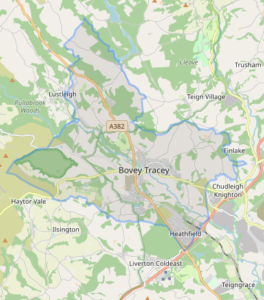
I do not know when the Pynsent family first acquired “Combe” or how large the farm was when they did so, but “Higher Combe,” “Middle Combe” and “Lower Combe” still covered 310 acres in aggregate when the census was taken in 1851.
The Devonshire Lay Subsidy Roll, shows that a John Pynson “senior,” (who almost certainly lived at “Combe”) contributed £30 to the Lay Subsidy (tax) in 1524, and a further £27 in 1544. These would have been extraordinarily large amounts for a simple yeoman farmer, as they would have expected to pay a few pounds – at most. John must have had another source of income. His son, another John, and his grandson Hugh Pinsent – who definitely came from “Combe” – were later to own a “dole” or share in a tin mine at “Owlscombe” (“Awliscombe”?) and I suspect it had been in the family for several generations. Hugh Pinsent was later to sue Stephen Collings, a partner in the venture, to recover the costs he incurred in 1611 when developing part of the mine – and Hugh’s sons William and John Pinsent were still squabbling with the Collings family as late as 1690. (Court of Chancery: C78/1238: 1690).
The Calendar of Devon Deeds Enrolled (1536 – 1604) show that John Pynson “senior” had wealth to spare and he loaned up to £10 a time to neighbours who wanted to buy up land that Henry VIII had acquired through his dissolution of the monasteries. There was relatively little risk to this as the mortgaged property was turned over to the lender if the borrower was unable to make his payments. It was either this John Pynson/Pinsent, or it may have been his son of the same name, who applied to the Heralds for a coat of arms (gules, a chevron engrailed, gules, between three etoiles, argent) in the late 1500s or early 1600s.
It was a shrewd move as a coat of arms showed that a man had the status of a “gentleman” and was able to rub shoulders with the County magistrates and other “gentry” – up to and including the Earl of Pembroke, the “Lord Warden” of the Stannary (tin) Court. The arms are not shown and may have been overlooked when the heralds made one of their periodic “Visitations” to Devon in 1620 (Visitation of Devon in 1620 ed. Frederic Thomas Colby) – or perhaps they had yet to be issued. The “Combe” Pynsents used the coat of arms down through the ages until the death of the second Sir William Pynsent, in 1765.
John Pinsent “senior” of “Combe” died in 1575 and his Will was proved in the “Prerogative Court of Canterbury” (33 Pyckering: 1575). This was fortunate as any wills filed in Exeter were destroyed by fire when the “Probate Registry” was bombed during the Second World War. John’s will says very little about his land holdings but addresses the needs of his widow and daughters. Nevertheless, as an after-thought, he leaves the residue “and a life interest in Comb Park” to his second son Hugh. John had almost certainly already set up his eldest son (John) as a businessman (actually a “Inn Keeper”) in Chudleigh, and placed his younger sons, Hugh, Walter, George and Thomas Pinsent as farmers in Ilsington, Teigngrace, Exmouth and Chagford (respectively). Collectively, these Pinsents’ descendants belong to a now broken branch of the family – The “Combe” Branch: Their lives are discussed in more detail elsewhere.
A John Pynsent from this line became a “prothenotary” (an official in the “Court of Common Pleas”) at the end of the English Civil Wars, during the interregnum between the execution of King Charles I and the return of his son, Charles, who ascended to the throne as Charles II in 1660. John had no living sons but he did have three daughters who married well … and it is worth noting that through one of them “Pynsent” became entrenched as a christian name that echoes down through the generations for over two hundred years. For instance, Mr. Pynsent C. Smith, of Hulcote, in Bedfordshire, was appointed Resident House Surgeon at the Infirmary at Bedford in 1884 (Bedford Mercury: 15th March 1884).
John Pynsent the “prothonotary” passed his fortunate to his nephew, William Pynsent, who also inherited his father’s wealth as a merchant, and also acquired the accumulated wealth of two other uncles (Robert and Humphrey). This made him a wealthy man! He bought a baronetcy (for £1,085) from King James II in 1687 and settled into a large estate at Urchfont, in Wiltshire.
William’s son, the second “Sir William Pynsent” married into the Jennings family and in so doing acquired a second estate at Curry Rivel in Somerset (“Burton Pynsent”). Sadly, he outlived his children and, as he had no immediate heirs, he left both to the Prime Minister (“The Great Commoner”) William Pitt – who used them to finance an Earldom! Pitt promptly abandoned the “House of Commons” and entered the “House of Lords” as the “Earl of Chatham.”
John’s sons’ descendants can (with some degree of speculation) be tracked down through several generations but as none that I know of made it through to the 20th Century. They belong to a broken branch that is discussed elsewhere. John’s sons’ descents are also touched on briefly in [“The Pynsent Baronetcy: The Trials and Tribulations of a Litigious Family: 1687 – 1765”].
The COMBE “Pinsents” shared Bovey Tracey with several less affluent branches of the family that are hard to track as there seem to be critical breaks in the parish records during the 1700s. Some of the lines; however, seem to have lived on through time and there were Pinsents living in Bovey Tracey into the early 1900s. The Pinsents of “Yeo Farm”, in Bovey Tracey probably evolved into the TEIGNMOUTH branch of the family. The s0-called BOVEY TRACEY branch comes from the town but its ancestry is poorly understood.
Huxbeare Farm: Hennock
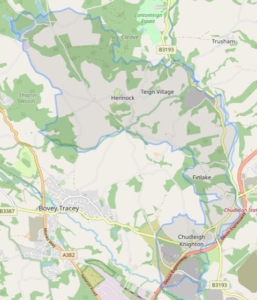
The lesser of the two land-owning families lived at “Huxbeare Barton”, on the Teign River flats to the west of what is now the B3193. They may have farmed there since the 1400s; however, their connection to the property only becomes clear in the early -mid 1500s, when parish records start up.
An “Inquisition Post Mortem” held in 1570 tells us that (the late) Christopher Chudleigh owned “Huxbeare Manor”, and the farm was run by a William Pinsent. He was probable the son of the John Pinsent “of Huxbeare” who died in 1561 and he may well have been the grandson of the Richard Pinsent of Hennock (presumably of “Huxbeare”) who paid £10 in lay subsidy in 1524/5, and £8 in 1544. The latter Richard and another William Pynsent, (possibly John’s brother?) were likely the “husbandmen” of Hennock who defended a cause of “trespass” brought by a local cleric, Thomas Harvy, in the “Court of Common Pleas” (CP 40/983) in 1507/8. The “Chudleighs” ranked among the local “gentry;” however, the “Pinsents” were farmers and were variously referred to as being “yeoman” or “husbandmen.”
In the absence of proof that Richard was indeed William’s grandfather, or that John was his father, I credit William Pinsent and his wife Joan with founding both the DEVONPORT and HENNOCK branches of the family. The DEVONPORT branch seems to run without break through into modern time and it has been given priority – hence the early Pinsents at Huxbeare are assigned to the DEVONPORT branch of the family. The HENNOCK branch is almost certainly an offshoot offshoot but its relationship to it has yet to be confirmed.
William’s grandson, Thomas Pinsent had four sons (Robert, John, Thomas and William Pinsent) through whom the lines seem to have descended. The eldest son, Robert, kept “Huxbeare” but, sadly, his twig on the DEVONPORT branch broke in the early 1700s. There were no surviving sons.
The next son, John Pinsent, extended the DEVONPORT line through to modern times. He moved to “Knighton,” a nearby “Manor Farm,” and one of his sons later settled at “Kelly” in Hennock and took to boiling and selling soap. The family prospered and later produced generations of “merchants” and “lawyers” as well as “farmers”. The family may not have had the social standing of their “COMBE” cousins (in Bovey Tracey) in the early days but they made up for it. The family acquired (in this case legitimately earned!) a baronetcy through Sir Richard Alfred Pinsent’s work as “Chairman of the Statutory Discipline Committee of the Law Society” in 1937/8. The DEVONPORT Branch is still going strong.
The HENNOCK branch of the family is (put for one missing birth record around 1660: see below) clearly an off-shoot of the DEVONPORT branch. It acquired a tannery in Hennock through marriage and later moved to “Pitt Farm” – which is south of Huxbeare and near Knighton (Chudleigh Knighton) in Hennock parish. This family also produced “merchants” and “lawyers,” and it can at least boast a Knighthood – if not a baronetcy. Sir Robert John Pinsent was a Judge on the Supreme Court of Newfoundland and a recognized authority on French fishery rights in Newfoundland. He received his knighthood from Queen Victoria in 1890. Sir Robert did a lot to raise British awareness of its “Oldest Colony.” His line (to which I belong) is still around. Its youngest male member arrived in 2023.
HENNOCK & DEVONPORT: THE EARLY YEARS
In a large, well populated parish the birth, marriage and death records may not be enough to define a family’s true structure . For instance, in a world full of Johns it may be difficult to sort out which John is which – and determine which of them died on any given date. It was not always the oldest – or the youngest for that matter!
However, the more affluent members of the community had periodic “subsidies” (taxes) to make to Central Government and ecclesiastical and manorial obligations to make as well. They were required to pay rents, “fines” and “heriots” to the Lord of the Manor, and tithes and church rates (poor-rates) to the local Vicar, whether they liked it or not!
Fortunately, Hennock’s “Overseer’s & Churchwardens’ Accounts” for the years 1598 to 1615, 1648 to 1692 and 1728 to 1834, have survived and they list the payments the farmers made and show how, and upon whom, the money was spent. The accounts help to tie individual farmers back to their land and a sudden change in name occurs when a farmer dies or a property is sold. It is often the man’s widow or son who takes over. The accounts also include references to payments to the parish poor – for shoes, smocks and nursing care “in their sickness” and for their burial when the time comes.
With regard to land ownership, the last ledger overlaps and is partially corroborated by County level “Land Tax Assessments” that were made between 1780 and 1831.
The Hennock “Accounts” tell us that the William Pinsent who held “Huxbeare” in 1570 paid the dues on the property until he died in 1601, and that his widow, Joan, paid them up to 1605. The responsibility then devolved to Robert Pinsent (1562 – 1626) who was his eldest surviving son. Robert married Dorothy Carpenter of Exmouth in 1586 and they seem to have lived at “Woodhouse”, another family farm, until Joan died. “Woodhouse” is south of “Huxbeare” on the west bank of the Teign River. According to William Honeywell, a gentleman living in Chudleigh who kept a diary, Robert rented “the Mill Marsh and meadow below” in 1604, and he (Mr. Honeywell) “went to Woodhouse and there sold to Robert Pynsent and his wife 36 pounds of pewter dishes at 7d per pound, which came to 21/- ” in 1605. The family was presumably moving up from wooden platters!
Robert and Dorothy had at least two sons, Robert Pinsent (1589 – 1650) and Thomas Pinsent (1597 – 1649) who married and had children. Robert, the elder, married Agnes Stevens of Ipplepen in 1617 and had several children including sons John Pinsent (1620 – 1629), Simon Pinsent (1622 – 1643) and Thomas Pinsent (1624 – 1655) baptized in Bovey Tracey. Why they crossed the parish boundary and settled in Bovey Tracey I do not know.
Robert “junior’s” wife, Agnes, was the daughter of a landed “gentleman” and she and her husband fought an action in the “Court of Chancery” [C2/CHASI/W100/34:1630] against John Washer over a piece of land in Ipplepen. I am not sure that it was a fair fight as John Washer was a “clerk of His Majesty’s Court of Kings Bench.” Robert Pinsent died in 1650 and his last surviving son, Thomas Pinsent, seems to have paid the parish rates on “Woodhouse Down” until his mother, Agnes, died, in 1655. What happened to Thomas Pinsent after her death is uncertain; he seems to disappear from the records.
Robert and Agnes’s eldest daughter, Margery (1618 – 1684) married George Pinsent (1603 – 1665), a boy from a neighbouring farm. He was from “Huish”, an upland farm east of the village of Hennock, and seems to have come from a completely different family line. This is the first of many inter-branch marriages that I know of. George was a Church Warden in Hennock in 1661. The couple had at least three sons. Their first, George, died young. The second, William Pinsent, may have been the “merchant” and “fisherman” who is so well documented in the New England records. If so, he went out to Massachusetts and was involved in a court case concerning the ownership of the catch of a fishing ketch called the “Lucy”, in 1678. William Pinsent married there, but I don’t think he had any surviving sons. He was living in Salem during the Witch Trials of 1692/3 and died in 1695.
It is worth noting that the Pinsent family held at least three farms in the early part of the 17th century. The DFVONPORT branch held “Huxbeare” (along with Cressida Downs, Knighton and Woodhouse Down – see below) and “Huish,” which was, as noted above, held by George Pinsent in the mid-1600s. It had been in his family for at least a hundred years. The third major holding was at “Warmhill” which was held by a Richard Pynsent and his wife in the early 1500s. However, it had passed out of the family at some point and Peter Earle was paying the rates for “that which was Pynsents” at “Warmhill” in 1650.
Although there are breaks in the “Accounts”, Robert and Dorothy’s second son, Thomas Pinsent (1597 – 1649) seems to have married Julian Stidstone, a widow from Dartington in 1617. Thomas inherited his father’s holdings in 1626. How much of the land (if any) was “freehold” and how much “copyhold” – in other words held by the family but owned by the Lord of the Manor and subject to rent and feudal obligations that had been written or “copied” into the Manor Roll – is uncertain. This particular Thomas was a Church Warden when Hennock’s tenor bell was cast in 1637, and his initials are said to be on the bell. He died in 1649 and his widow paid the parish rates for “Huxbeare” and several other “tenements” including “Knighton” and “Crosseda Down” until her sons were able to take them over. I am not sure where “Crosseda Down” is. Thomas and Julian Stidstone had had four sons, Robert Pinsent (1624 – 1671), John Pinsent (1626 – 1663), Thomas Pinsent (1633 – 1701) and William Pinsent (1638 – xxxx) who between them form the foundation of the modern DEVONPORT and HENNOCK branches of the Pinsent family.
When Thomas Pinsent “senior” died, he left “Huxbeare” and “Crosseda Down” to his eldest son, Robert Pinsent and his descendants farmed the land until they ran out of male heirs, in 1711. He gave “Knighton,” (now Chudleigh Knighton) at the south end of the parish to his second son, John Pinsent. It was this John’s descendants that later moved to Devonport. They became merchants there and in Newton Abbot and then moved to Birmingham where several entered the legal profession. This branch of the family can be traced down into modern time.
Thomas Pinsent, the third brother married Julian Wilmeade after his father’s death and, through her, acquired a tannery at “Slade,” which was then in the northwest corner of Hennock parish but is now in Bovey Tracey. It was probably their son, another Thomas (xxxx – 1696) that married Ann Waters and fathered the Thomas Pinsent who first farmed at “Pitt” in Hennock. The link is a little tenuous, so his descendants have been assigned to a separate branch of the family, the HENNOCK branch. “Pitt”, of course, is on the B3344 between “Woodhouse” and “Knighton”.
As for the fourth son, William Pinsent, on-line internet sources suggest that the Thomas Pinsent who married Mary Knott in Tiverton in 1734/5 was one of his descendants. That may be true; however, I cannot prove it. Thomas and Mary founded the TIVERTON line.
HENNOCK: FAMILY HISTORY
A few days before his marriage to Jane Sparrow in 1843 Thomas Pynsent (1808 – 1887) of “Pitt Farm” and later the builder of “Pitt House” in Hennock wrote a memorandum describing what he thought he knew of his ancestry.
(I) My great great great great great grandfather Robert Pynsent of Huxbere buried 1625.
(II) My great great great great grandfather Thomas Pynsent, the sonne of Robert Pynsent of Huxbeare and of Dorothy Carpenter of Exminster married 1586.
(III) My great great great grandfather, Robert sonne of Thomas Pynsent of Huxbeare and Julian Stidstone of Dartington (widowe) married 1617, baptized 1624.
(IV) My great great grandfather, Thomas the sonne of Robert Pynsent and of Urith his wife, baptized 1663.
(V) My great grandfather, Thomas the son of Thomas Pinsent baptized Feb. 1690.
(VI) My grandfather, John the son of Thomas Pinsent baptized October 20th, 1728.
(VII) My father, Charles son of John and Susanna Pinsent baptized June 29th, 1766.
(Myself) Thomas, son of Charles and Mary Pinsent baptized September 15th, 1808.
The above are extracted from the Registers of the Parishes of Hennock, Bovey Tracey and Wolborough in the County of Devon and show my paternal Ancestors in the direct line closing with my baptism. From this day forward I purpose adopting the orthography of the family name used in former times and thus subscribe myself this eleventh day of July one thousand eight hundred and forty three:
(sgd:) Thos. Pynsent.
Thomas had grown up in Hennock and attended “Pynsent’s Free School” in Chudleigh, which had been founded by a “prothenotary” (senior official) of the “Court of Common Pleas” in 1668. The building still sports a plaque commemorating its foundation [albeit the colour scheme was wrong when I last saw it!]. Mr. Pynsent’s bequest is described in the attached story of the Pynsent Baronetcy [The Pynsent Baronetcy: Trials and Tribulations of a Litigious Family]. I rather suspect that Thomas hoped to find a connection between his family and that of the baronet when he went digging in the registers. However, there was none to be had. John Pynsent (the “prothenotary”) was from the “COMBE” branch of the family [The Pynsent Baronetcy: The Trials and Tribulation of a Litigious Family: 1687-1765]. Thomas did not find a link and, to his credit, he did not pretend that he did!
It is interesting to note that Thomas not only decided to adopt the surname “Pynsent” himself, but he brow-beat several of his cousins into following suit. Because of this, there is now a “HENNOCK” family line in Australia that uses that spelling! They have no connection to Sir William Pynsent either.
Thomas was correct about his immediate family, of course, and determined that he was the great-grandson of the “Thomas Pinsent of Pitt” (1691 – 1777) who is described on a memorial in Hennock Parish Church. The stone shows that Thomas died in 1777 aged 87, after 63 years of marriage. This is useful information unless – as I rather suspect – it was Thomas Pynsent who arranged for the placement of the memorial and reflects his interpretation of events! If the facts are true, and I have no reason to doubt them, the plaque shows that his great-grandfather must have been the Thomas who was born in Bovey Tracey, in 1691. If so, he was the son of another Thomas: – presumably “Thomas Pinsent (1657 – 1696) of Bovey Tracey” and his wife, Ann Waters. Here we see the beginnings of the HENNOCK branch of the family (see elsewhere).
According to the memorandum, the latter Thomas (who was Thomas Pynsent’s great, great grandfather) was the son of Robert (1624 – 1671) and Urith Pinsent, of Huxbeare. However, if this were so, he was born in 1663 and married in January 1678 when he was 15 years old! The first child (Susannah Pinsent) by the marriage was born in July, six months later, so it could have been a forced marriage, I suppose. However, I think it is unlikely. The link back to Huxbeare is probably correct; however we should probably look for another Thomas.
I prefer to think that his great great grandfather was an unrecorded son of Thomas Pinsent (1633 – 1701), the “tanner” at “Slade”, and Julian Wilmeade. The dates fit better and there are annoying breaks in the parish record around then. The attribution would also explain why their grandson Thomas Pinsent (1691 – 1777) of “Pitt” owned the tannery in 1737. At least, he paid the parish rates for it.
The DEVONPORT, HENNOCK and possibly also the TIVERTON lines seem to root back to “Huxbeare.” The other lines are more difficult to follow; however, the TEIGNMOUTH line most likely came from the farm at “Yeo” in Bovey Tracey. The BRISTOL, AUSTRALIA and BOVEY TRACEY lines likely originated from the same parish. As for the INDIA line – I am not so sure where it came from. Perhaps it was a late conversion from PINSON or PENSON. For more information on all these family check out the BRANCH SUMMARIES and biographies.
Next: Pinsent Branch Summaries