Vital Statistics
Christopher Roy Pinsent: 1922 – 2015 GRO0149 (Baronet, Artist and Lecturer, Camberwell)
Susan Mary Scorer: 1927 – 2017
Married: 1951: Fotheringhay
Children By Susan Mary Scorer:
Daughter (GRO0566)
Daughter (GRO0491)
Sir Thomas Benjamin Roy Pinsent: 1967 – xxxx
Family Branch: Devonport
PinsentID: GRO0149
Click here to view close family members.
Christopher Roy Pinsent was the eldest son of Sir Roy Pinsent by his wife, Lady Mary Tirzah Pinsent (née Walls). He was born in Birmingham in 1922 and grew up at “Little Wick” in Selly Oak, southwest of Birmingham, with a younger brother (Michael Roy Pinsent) and a younger sister. Sir Roy was a solicitor and, on the death of his father, the head of the family law firm, “Pinsent and Co.”. Christopher’s parents took their family on trips to France and Spain in the mid-1930s but Christopher (“Chris”) was, sent away to school. He was sent to the “Down School”, at Colwell, near Malvern where he came under the influence of its talented art master, Maurice Field.
Christopher was not the first Pinsent to attend the school. Several of his grandfather’s brother Adolphus Ross Pinsent’s South American family had been there before him. From there, Christopher went to “Winchester College” (1936-1940), the “Public” (private) school where his uncle, John Ryland Pinsent, had taught from 1926 to 1934. Why there, I am not sure as his younger brother Michael was sent to his father’s old school – “Marlborough College”.
Christopher left school during the war and joined the “Royal Air force.” I do not know where he served; however, he was as an “aircraftsman” in 1941 and a “senior aircraftsman” in 1945. After the war, he attended “Camberwell College of Art and Crafts,” in Peckham, in Surrey, and studied under William Coldstream, and others. When he graduated, in 1948, he was taken on as the art master at “Charterhouse School” (yet another “Public” (private) school). and he was still there in 1951 when he married (Birmingham Daily Post: Friday 19th January 1951). Christopher’s wife, Susan Mary Scorer was a “teacher” and the daughter of a “farmer.” They had a predictably up-scale wedding at St. Mary and All Saints in Fotheringhay, in Northamptonshire, on 27th January 1951 (Peterborough Standard: Friday 29th June 1951). Christopher’s sister, was one of the three adult bridesmaid’s and his brother Michael served as Christopher’s best man. The couple left for a honeymoon in Italy after a “reception for 200” held at the bride’s family home, at Walcott Lodge in Fotheringhay. Christopher and Susan had a son, (GRO1106) and two daughters, Daughter (GRO0566) and Daughter (GRO0491) in the years that followed.
Christopher returned to “Camberwell College” to teach drawing and painting in 1962. An item in the “Birmingham Daily Post” describes the considerably contribution to the world of art made by “old-boys” from the “Down School” who, like Christopher, had been introduced to oil painting by Mr. Field. Clearly, he was not alone (Birmingham Daily Post: Tuesday 17th January, 1956)! Christopher stayed on at “Camberwell College” as a “lecturer” and “tutor” through to 1986. He acceded to the family baronetcy when his father, Sir Roy Pinsent, died, in 1978 (www.thepeerage.com/p52033.htm).
Christopher was a friend of Euan Uglow and an item on his work describes what happened after Christopher brought a lady, Julia Scott, to visit Euan in his Studio on 31st March 1961. Apparently, Christopher later wrote to Uglow indicating her desire to buy one of the three nudes she had seen there; however, Christopher stressed that she had no desire to stand in the way of the “Tate Gallery”, should it wish to buy her first choice (Euan Uglow: The complete Paintings: Catalogue Raisonne). Uglow was one of what came to be called the “Camberwell School” of artists. In 2011, Sir Christopher Pinsent (as he was then) wrote an obituary for Christopher Pemberton who was a fellow teacher at the “College” and a “Camberwell School” artist. It was published in “The Guardian” on 6th February 2011.
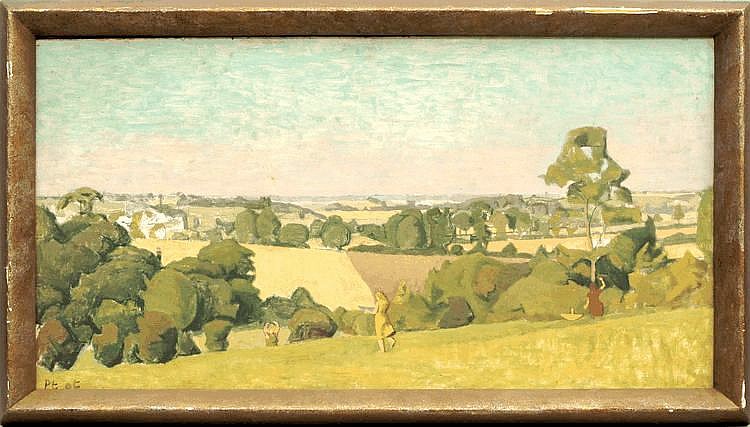
Unfortunately, I can find very few of Christopher’s paintings referenced on-line; however, one, entitled “A Summer’s Landscape” came up for sale on a live-auction site in September 2014 (liveauctioneer.com/item/29818916…). It sold for £340. Another, entitled “Southwold Railway: c1960s (Oil and Pencil of Board)” was shown in an exhibition celebrating “40 Years of Paining by Camberwell Students and Teachers: 1945 – 1985” held at the “Belgrave and St. Ives Modern Contemporary Art Gallery” from 7th to 20th November 2015. This can be seen on-line, at “belgravestives.co uk/Exhibitions …”
Christopher and Mary lived at “22A Lower Marsh, London S.E. 1” for a few years before moving to a house called “The Chestnuts,” on Castle Hill in Guildford, in 1957. According to one of Christopher’s daughters, when discussing the house with a reporter, it was in a very dilapidated state when her father bought it, but he had done all he could on a “lecturer’s” salary to bring it back to a suitable state of repair.
The house had previously belonged to Charles Dodgson’s (a.k.a. Lewis Carroll, the author of “Alice in Wonderland”) sisters, and Charles had evidently died there in 1898. Christopher seems to have tolerated the inevitable visitors who came to pay homage to Dodgson. Eventually, after one of the chestnut trees by the house came down in the “great storm” of 1987, he decided it was time to sell. A few years later, the family moved to Chiddingfold, near Haslemere, in Surrey.
Christopher was, like his father, not above firing off letters to newspapers on matters of topical interest. They seem to appear in the “London Times” at irregular intervals. In 1959, he wrote about the then current fad of including colour into modern building design – to the detriment, he felt, of taste (The Times: 15th October 1959). He was enraged by a plan to demolish Shalford Park Manor House and replace it with a water works. Surely the site could be held for Guildford University and the Water Board could find an already compromised site for its plant (Surrey Advertiser: Saturday 30th January 1995)?
Another issue he was concerned about was transportation policy. He argued that the cost of driving a car was so front-end loaded (purchase price, insurance, taxation etc.) that people insisted on using their cars to the detriment of public transport. He felt that car “users” should pay more and a fair approach would be for government to lower the cost of the initial purchase (reduce taxes etc.) and recover the money by increasing the price of petrol (“gasoline”) (London Times: February 28th 1976 and September 11th 1980). Personally, he preferred public transport and he stressed how difficult it was to take bicycles on trains (London Times: 25th August 1982). He claimed to have taken his family on several successful bicycling tours of England and Wales over the years and had taken full advantage of the rail system.
Later on in life, he focused more on medical matters, discussing “no fault medical compensation” on 13th July 1989 and “National Health (Service) Hospitals” on 27th November 1989. Still, his main interest was always to be art. He wrote a piece for the “London Times” on “Art, Letters and Contemporary Trends” on 11th February 1991. He objected to modern “fads” and applauded traditional methods of teaching.
In 1981, Sir Christopher agreed to be the “patron” of an appeal to restore the “Burton Steeple” – a monument built by William Pitt, Earl of Chatham, in appreciation of a legacy given him by Sir William Pynsent in 1765. Sir William, who was from an entirely different and much earlier baronetcy, owned large estates at Urchfont, in Wiltshire, and Curry Rivel, in Somersetshire. He died without heirs and to the consternation of many left pretty much everything to Pitt, apparently in recognition of his successful running of the Country as Prime Minister during the “Seven Years War”. The monument, like Sir Christopher’s house in Guildford was badly in need of repair in the 1970s and 1980s and, through his efforts and those of many others, including my father, Dr. Robert John Francis Homfray Pinsent, the “Burton Pynsent Charitable Trust, Pynsent Column Appeal” was eventually launched. The “Getty Foundation” and the “Heritage Trust” contributed and the remedial work completed in the early 1990s.
Sir Christopher died in Guildford, Surrey, in August 2015. He was 93 years old. His widow, Susan, died two years later. His son Thomas Benjamin Roy Pinsent acceded to the title.
Family Tree
GRANDPARENTS
Grandfather: Richard Alfred Pinsent: 1852 – 1948
Grandmother: Laura Proctor Ryland: 1855 – 1931
PARENTS
Father: Roy Pinsent: 1883 – 1978
Mother: Mary Tirzah Walls: 1897 – 1951
FATHER’S SIBLINGS (AUNTS, UNCLES)
Clive Pinsent: 1886 – 1948
John Ryland Pinsent: 1888 – 1957
Laurence Alfred Pinsent: 1894 – 1915
Philip Ryland Pinsent: 1897 – 1916
MALE SIBLINGS (BROTHERS)
Michael Roy Pinsent: 1927 – 2019
Please use the above links to explore this branch of the family tree. The default “Next” and “Previous” links below may lead to other unrelated branches.